Key Points
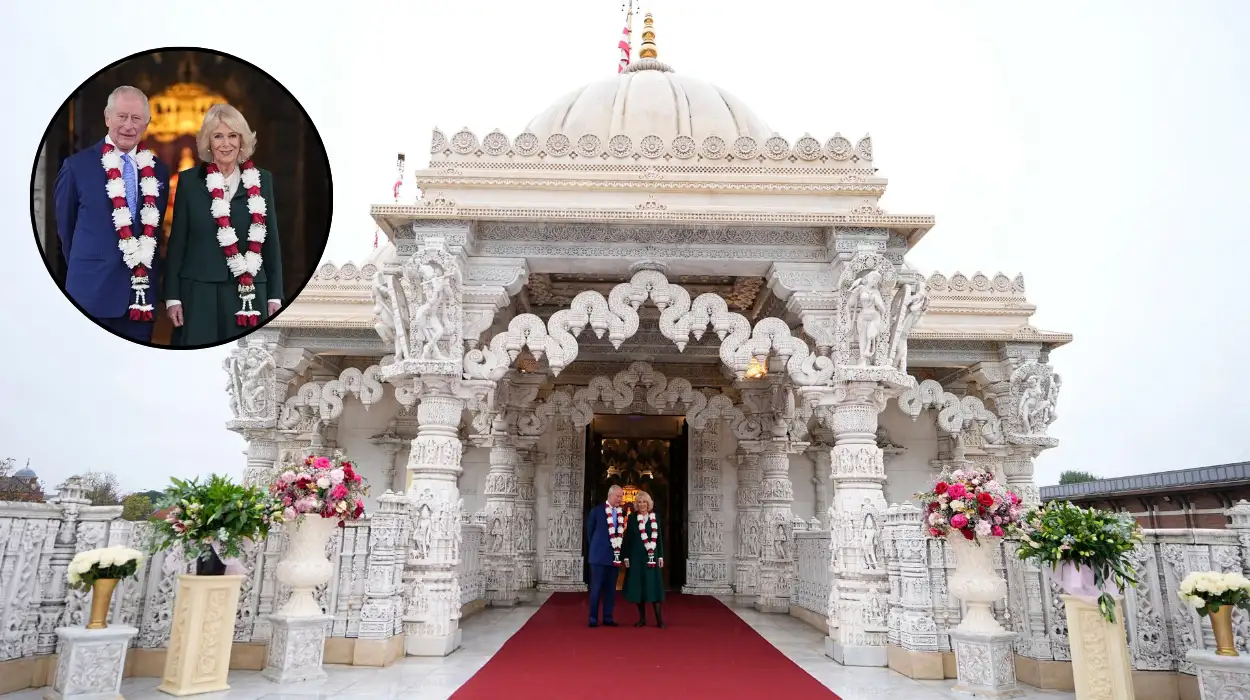
- King Charles III and Queen Camilla visited BAPS Shri Swaminarayan Mandir in West London to celebrate its 30th anniversary.
- The royal couple was garlanded with flowers and wished a belated “Happy Diwali” to worshippers.
- The visit highlighted the significance of Hindu diversity and cultural respect in the UK.
- The temple, constructed with classical Vedic principles, is renowned for its intricate stone carvings and architectural beauty.
- This marks Charles’s fourth visit to the temple, underlining his long-standing relationship with the Hindu community.
- Multiple sources, including The Independent, BBC, and The Guardian, report detailed accounts of the event.
Why Did King Charles III and Queen Camilla Visit the Hindu Temple?
The visit of King Charles III and Queen Camilla to the BAPS Shri Swaminarayan Mandir in West London was a momentous occasion, symbolising the UK’s commitment to religious harmony and cultural diversity. On the occasion of its 30th anniversary, the royal couple engaged directly with members of the Hindu community, receiving warm welcomes and traditional garlands. As reported by The Independent’s Sophia Smith, Charles and Camilla’s visit underscores their recognition of the importance of multiculturalism within Britain.
What Is the Significance of the BAPS Shri Swaminarayan Mandir?
Constructed using authentic Vedic architectural principles, the temple is an emblem of devotion, craftsmanship, and cultural heritage. Its intricate carvings in marble and limestone, fashioned entirely by skilled artisans in India, symbolizes the extensive cultural exchanges and religious pluralism championed by the British monarchy. The temple’s architecture is a fusion of craftsmanship and spiritual symbolism, drawing devotees and tourists alike to appreciate Hindu traditions.
As noted by The Guardian’s Rahul Singh, the temple’s design eschews steel structural elements, adhering wholly to ancient Vedic standards, thereby representing traditional spiritual architecture and craftsmanship at its finest.
How Did the Royal Visit Unfold?
(According to reports from BBC and The Independent)
The royal couple was greeted with traditional Hindu ceremonies, including being garlanded with flowers as they arrived. Priests dressed in flowing orange robes performed rituals, placing rose and carnation garlands around their necks. The King was also blessed with sacred threads called nada chadi, symbolising enduring bonds, as explained by a priest present during the event.
During the tour, Charles and Camilla engaged with community members, clergy, and volunteers. The visit was not just ceremonial; it served as a reaffirmation of Britain’s multicultural identity. As Charles remarked,
“We celebrate the diversity that makes Britain so unique,”
reiterating the monarchy’s support for religious and cultural expression.
What Was the Message Behind the Visit?
The incident’s broader message was one of unity, respect, and inclusion. It served as an official acknowledgment of the vibrant Hindu community residing in Britain and the importance of religious harmony. As reported by The Guardian, the royal couple’s acknowledgement of Diwali – the Hindu festival of lights – further emphasised their support for cultural celebrations across faiths.
The visit also aimed to strengthen ties with the local Hindu community, highlighting the British monarchy’s evolving role as a symbol of national unity that respects and celebrates diversity.
How Long Has Charles Been Visiting the Temple?
Charles’s ties to the temple date back over two decades. His previous visits include:
- In 1996, as Prince of Wales, during his first known visit to the temple.
- In 2001 and 2009, when he toured the building, demonstrating his ongoing support.
- The visit in 2025 marked his fourth, illustrating his lasting relationship with the community.
As reported by The Telegraph, Charles’s visit in 2009 was particularly significant, coinciding with his engagement with multiple faith communities across the UK.
What the Experts Say About the Royal Visit
Religious leaders and community spokespeople have expressed admiration for the royals’ participation. According to Dr. Anjali Patel, a Hindu scholar cited by The Independent, such visits are crucial for promoting intercultural dialogue and mutual respect.
The temple’s secretary, Mr. Suresh Patel, also stated,
“This visit reaffirms our community’s importance in the UK, and we’re grateful for the royal support.”
What Was the Public and Media Reaction?
The event garnered widespread media coverage across Britain and beyond. Articles emphasized the significance of the royal visit for promoting religious tolerance. Social media channels displayed images of the couple receiving traditional blessings, highlighting their embrace of Hindu customs.
Public reactions ranged from praise for the monarchy’s cultural sensitivity to discussions on the evolving role of the royal family in public life. The BBC reported that the event was seen by many as a positive step towards embracing Britain’s multicultural reality.
What Are the Broader Implications of the Visit?
This historic visit signals a broader cultural shift, portraying the monarchy as a unifying institution in a diverse Britain. Political analysts cited in The Guardian suggest that it reflects the monarchy’s strategic effort to modernise its image and connect with younger, multicultural generations.
The temple’s 30th anniversary celebration, enhanced by the royal visit, also underscores ongoing efforts to recognise non-Christian faiths within official British culture, advancing a narrative of inclusion and mutual respect.
The visit of King Charles III and Queen Camilla to the BAPS Shri Swaminarayan Mandir marked a milestone in Britain’s ongoing journey to embrace cultural and religious diversity. Garnering praise from community leaders, religious figures, and the media alike, the event exemplified the monarchy’s evolving role in fostering national unity in an increasingly multicultural Britain. This visit not only honoured over three decades of the temple’s existence but also set a precedent for future engagement with the Vedic and Hindu communities across the United Kingdom.