Key Points
- The Design Museum unveiled the Stone Demonstrator, a 1:1 scale pre-tensioned stone structure at Earls Court, London.
- The installation measures 6.5m by 6.5m, with three storeys made from stone blocks connected by steel tendons.
- Stone Demonstrator’s carbon emissions are approximately 3,000kg CO2, about 90-92% lower than steel or concrete frame buildings.
- The stone facade emits at least 90% less carbon than conventional clay bricks used in London.
- Prefabricated modular elements reduce construction time and can be dismantled and reused.
- Designed by Groupwork with engineers Webb Yates and Arup; funded by Future Observatory and UKRI Arts and Humanities Research Council.
- Amin Taha, Groupwork founder, highlights the installation as a low-carbon alternative, not a sentimental nod to stone.
What is the Stone Demonstrator installed at Earls Court?
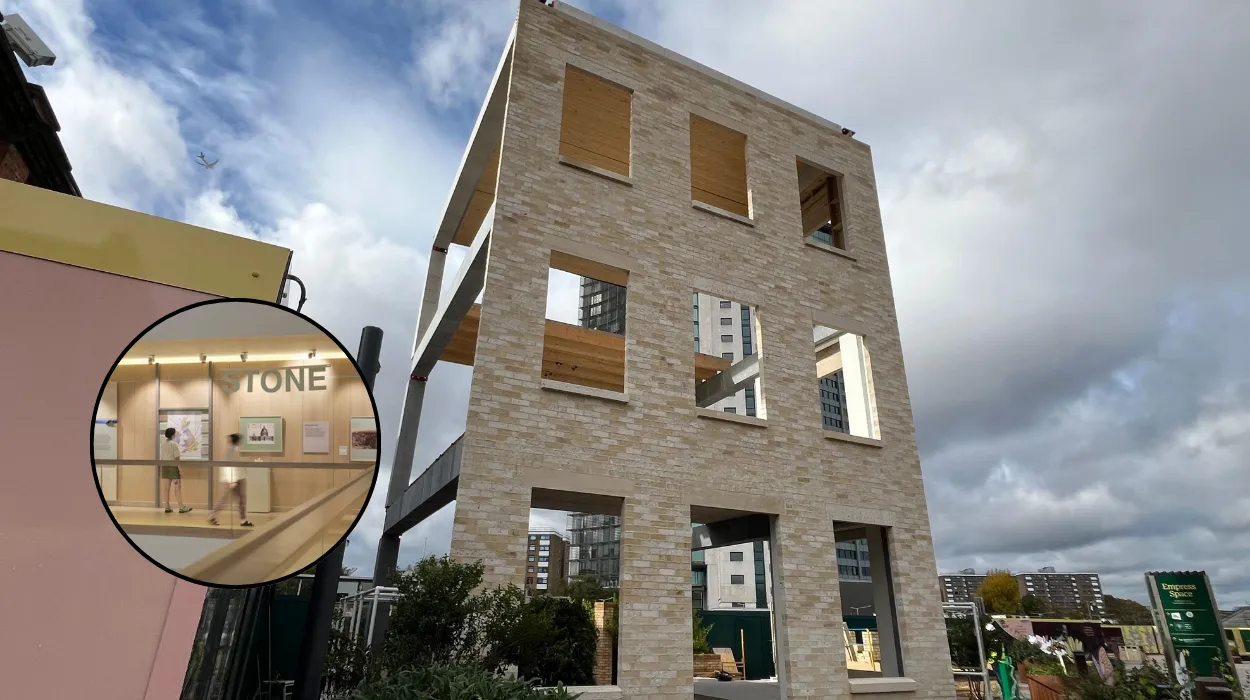
The Design Museum has launched a temporary structure known as the Stone Demonstrator at the Earls Court development site in west London. This installation serves as a full-scale (1:1) prototype for pre-tensioned stone structures, aiming to promote natural stone as an alternative building material to conventional concrete and steel frames. The Stone Demonstrator stands three storeys high and covers an area of 6.5 metres by 6.5 metres.
- Key Points
- What is the Stone Demonstrator installed at Earls Court?
- How does the Stone Demonstrator reduce carbon emissions compared to traditional construction?
- Who designed and funded this low-carbon stone structure?
- What are the practical advantages of using pre-tensioned stone in construction?
- What has Amin Taha said about the importance of this project?
- Is the Stone Demonstrator accessible to the public?
- What broader impact does the Stone Demonstrator aim to have on construction?
The structure features stone blocks connected by steel tendons, which are tensioned to create strong, compressed beams and columns. This engineering method has enabled the assembly of floorplates combining pre-tensioned stone slabs with timber joists, topped with a roof made from dowel-laminated timber. A self-supporting stone brick facade completes the build, designed to significantly reduce carbon emissions compared to traditional materials.
How does the Stone Demonstrator reduce carbon emissions compared to traditional construction?
According to academic research cited by the Design Museum, the Stone Demonstrator produces only 3,000 kilograms of carbon dioxide emissions. This figure represents a drastic reduction—about 90 to 92% less carbon is emitted compared with steel-framed buildings clad in fired clay bricks, which typically emit around 40,000kg of CO2. Similarly, reinforced concrete frame buildings with clay brick facades emit around 32,000kg of carbon.
The stone bricks used in the demonstration are said to have at least 90% lower embodied carbon than the clay bricks traditionally employed in London’s construction. This substantial decrease situates the Stone Demonstrator as an eco-friendly alternative, directly addressing the construction sector’s significant contribution to greenhouse gas emissions.
Who designed and funded this low-carbon stone structure?
The architectural design was led by Groupwork, headed by founder and chairman Amin Taha. Engineering input came from Webb Yates and Arup, bringing nearly two decades of collaboration and testing in prototyping such stone structures.
Funding for the project was provided by Future Observatory, the Design Museum’s national research initiative centred on the green transition, along with a grant from the UKRI Arts and Humanities Research Council. This partnership underscores a growing institutional interest in innovative materials to combat climate change in the construction industry.
What are the practical advantages of using pre-tensioned stone in construction?
The Stone Demonstrator exemplifies several practical benefits of pre-tensioned stone structures. As highlighted by the Design Museum, the use of prefabricated modular elements means construction time on site is reduced compared to traditional masonry or concrete builds. The prefabricated components can also be dismantled and reused, facilitating sustainability through potential circular use.
The structure’s combination of stone and timber elements showcases a hybrid approach that optimises natural materials without compromising strength or durability. This approach encourages the adoption of environmentally benign alternatives at scales beyond temporary installations.
What has Amin Taha said about the importance of this project?
Amin Taha, quoted in the Design Museum’s coverage, emphasised that the project is
“intended to demonstrate a viable alternative to everyday building methods but at a fraction of the embodied carbon.”
He elaborated that the stone structure
“brings together almost two decades of prototyping and testing by Webb Yates, The Stonemasonry Company, Ateliers Romeo and Arup.”
Taha stressed that the motivation behind the Stone Demonstrator was not nostalgia or sentimentality:
“Its purpose is not to promote stone for sentimental reasons but as an ultra-low-carbon alternative to reinforced concrete and steel structures clad in fired clay bricks. At 90% less embodied carbon than concrete and steel frames and fired clay bricks, it’s the ethical choice.”
This statement positions the project squarely within sustainable construction innovation rather than heritage revival.
Is the Stone Demonstrator accessible to the public?
Yes, the Stone Demonstrator’s ground floor and the adjoining park at Earls Court are open to the public. This accessibility allows visitors to experience firsthand the scale, materiality, and architectural possibilities of low-carbon stone construction. It serves as both an educational and research tool, inviting public engagement with sustainable building practices.
What broader impact does the Stone Demonstrator aim to have on construction?
Through this installation, the Design Museum and its collaborators seek to influence the building sector’s material choices by showcasing how natural stone can significantly reduce embodied carbon emissions. The project aligns with wider agendas to mitigate climate change impacts by rethinking conventional construction methods reliant on carbon-intensive materials like concrete and steel.
By pioneering a scalable, prefabricated stone structure, the initiative provides empirical data and a visible proof-of-concept that could inform future architectural and engineering standards. Ultimately, the demonstrator acts as an advocacy platform for green innovation within urban development.