Key Points
- More than 100 roads in West London will be closed to any form of vehicular access for the 60th anniversary of the Notting Hill Carnival.
- The closure of several streets will begin at 6am on Sunday, 30 August, and end at 6am on Tuesday, 1 September.
- Parking will be strictly banned starting 11:59pm on Saturday, 29 August, and the Kensington and Chelsea Council encourages residents to move their cars.
- Notting Hill Gate (A402) is one road in particular that will face major restrictions for the first time where it will only be accessible by buses and pedestrians from Campden Hill Road to Kensington Church Street.
- Transport for London (TfL) has announced Tube station disruptions, bus rerouting, and temporary banning of e-scooters and Santander Cycles.
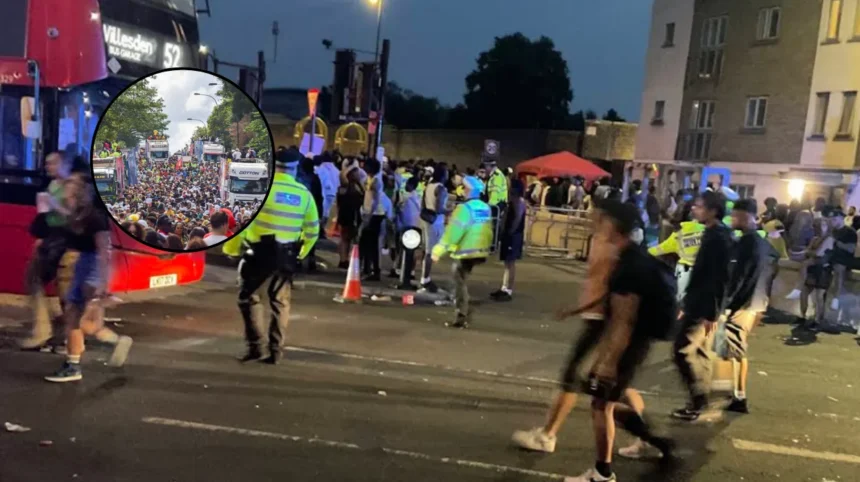
West London (West London News) August 31, 2026 — Hundreds of thousands of revelers are descending on West London for the landmark 60th anniversary of the Notting Hill Carnival, but the historic Caribbean street festival brings significant local travel disruption. More than 100 roads across Notting Hill, Ladbroke Grove, and surrounding neighbourhoods have been completely shut down to private vehicles until Tuesday morning. Royal Borough of Kensington and Chelsea Council and Westminster City Council have confirmed that only emergency services and pre-authorised vehicles will be permitted inside the official festival perimeter. Residents who failed to move their cars prior to 11:59pm on Saturday, 29 August, face towing or strict access refusals throughout the Bank Holiday weekend.
What Are the Confirmed Road Closures for the 2026 Notting Hill Carnival?
As reported by Louis Dargavel Corbett of MyLondon, the road closure perimeter covers the vast majority of West London’s residential heartland surrounding the carnival parade route. Transport for London (TfL) confirmed that primary road blockages commenced at 6:00am on Sunday, 30 August, and will remain in place until at least 6:00am on Tuesday, 1 September.
The central artery of the area, the A402 Notting Hill Gate, is subject to high-level restrictions. As detailed by TfL traffic travel bulletins, Notting Hill Gate is fully closed to general vehicular traffic between Campden Hill Road and Kensington Church Street/Palace Gardens Terrace between 10:00am and 10:00pm on both Sunday and Monday, operating exclusively for buses and pedestrians. Furthermore, Westminster City Council confirmed that Bayswater Road is subject to a westbound closure starting from Lancaster Terrace, whilst eastbound traffic is maintained.
The full list of confirmed street closures across the Royal Borough of Kensington and Chelsea and the City of Westminster includes:
- Aldridge Road Villas
- Alexander Mews
- Alexander Street
- Alfred Road
- Artesian Road
- Bark Place
- Bayswater Road (Westbound restrictions)
- Bishops Bridge Road (from Porchester Road to Westbourne Grove)
- Botts Mews
- Bridstow Place
- Brunel Estate
- Caradoc Close
- Caroline Close
- Caroline Place
- Chapel Side
- Chepstow Road
- Courtnell Street
- Dartmouth Close
- Dawson Place
- Durham Terrace
- Elgin Avenue
- Fermoy Road
- Fosbury Mews
- Great Western Road
- Ladbroke Grove
- Monmouth Place
- Monmouth Road
- Moorhouse Road
- Moscow Place
- Moscow Road
- Needham Road
- Newton Road
- Notting Hill Gate
- Westbourne Grove
How Is Public Transport and Bus Routing Impacted?
As reported by MyLondon transport correspondents, Transport for London has warned that surface and underground transit networks are experiencing severe operational adjustments. Buses are heavily rerouted because key thoroughfares are inaccessible to normal traffic flow. Daytime routes including the 7, 18, 23, 27, 28, 31, 36, 52, 70, 228, 295, 302, 316, and 328, alongside night routes N7, N27, N28, and N31, are terminating short or diverting. Buses operating from the north terminate at Harrow Road near the Prince of Wales pub, whilst southern services turn back at Notting Hill Gate. Express festival shuttle services, such as the 7X, 18X, 23X, 36X, and 148X, have been deployed to carry attendees to perimeter drop-off points.
London Underground stations near the festival site face extensive control measures or outright closures to prevent overcrowding:
- Ladbroke Grove: Completely closed all day on Sunday and Monday.
- Notting Hill Gate: Exit-only between 11:00am and 6:00pm. District and Circle line trains will not stop at the station during these hours, and line interchanges are suspended.
- Westbourne Park: Exit-only / no entry starting from 11:00am.
- Holland Park: No entry from 11:00am to 3:00pm; completely closed from 3:00pm onwards.
- Royal Oak: Closed to incoming passengers from 11:00am; fully closed at 6:00pm.
- Latimer Road: Subject to intermittent closures throughout the day and shutting permanently at 11:00pm.
Furthermore, Santander Cycles docking stations inside the perimeter are deactivated until 8:00am on Tuesday, 1 September, and geofenced speed and parking limits are active for all commercial dockless e-bikes and e-scooters.
Background of the Development
The Notting Hill Carnival originated in 1966 as a community-led outdoor festival organised by local Caribbean immigrants and civil rights activists, most notably Rhaune Laslett, to foster cultural unity following racial tensions in West London during the late 1950s. Over six decades, the event has expanded from a neighborhood street gathering of a few hundred people into Europe’s largest street festival and the second-largest carnival in the world after Rio de Janeiro.
As the attendance numbers swelled past one million participants in recent decades, the physical infrastructure of Notting Hill’s narrow Victorian residential streets has faced mounting pressure. In response, local local authorities — specifically the Royal Borough of Kensington and Chelsea, Westminster City Council, and the Metropolitan Police Service — systematically escalated traffic management protocols to safeguard public movement, ensure access for emergency vehicles, and manage crowd density. The 2026 closures mark the 60th anniversary milestone, bringing unprecedented coordination between Transport for London and local councils to enforce one of the largest security and traffic exclusion zones in London’s history.
Prediction: How Will This Impact Residents, Commuters, and Local Businesses?
The extensive road closures and public transport disruptions will directly impact three distinct local stakeholder groups throughout West London:
1. Local Residents
Residents within the exclusion zone face severe mobility restrictions. Those who did not move their personal vehicles out of the designated zone prior to the Saturday night deadline are unable to drive out or park near their properties until Tuesday morning. Home deliveries, ride-hailing services, and emergency maintenance visits are completely halted within the closed perimeter. Additionally, local residents will experience heavy foot traffic, elevated noise levels, and restricted residential access points requiring proof of address at council security checkpoints.
2. Commuters and Cross-Town Motorists
Non-carnival commuters and motorists seeking to cross West London face substantial delays. The closure of major arterial corridors, such as Notting Hill Gate (A402) and partial closures on Bayswater Road, forces heavy traffic diversions onto the A40 Westway, Holland Park Avenue, and Shepherd’s Bush routes. Surface bus diversions and the complete closure of key underground stations like Ladbroke Grove will force daily workers to rely on alternative hubs like Shepherd’s Bush or Paddington, adding significant travel time to regional journeys.
3. Business Owners and Local Logistics
Commercial establishments within the carnival perimeter experience a dual financial impact. Retailers, pubs, and food vendors catering directly to carnival-goers are projected to see a surge in footfall and single-weekend revenue. Conversely, businesses that rely on standard freight deliveries, physical service calls, or normal drive-by customer traffic face a complete standstill in routine trading. Logistics providers and supply chain networks servicing West London will be required to reroute around the perimeter, incurring higher fuel costs and extended delivery schedules across the entire Bank Holiday weekend.