Key Points
- Hammersmith & Fulham Council says fully restoring Hammersmith Bridge for motor traffic would cost about £300m.
- The council report says there is “no financial option available” that would allow full restoration.
- Officers say the bridge may now need a phased repair approach to keep it open for pedestrians, cyclists and river traffic.
- The report warns the bridge could fully close again on safety grounds in the short to medium term without further major investment.
- The council has submitted a pre-application to the Department for Transport’s Structures Fund for works costing £128m, with a decision expected in the autumn.
- The fund’s deadline of 31 March 2030 rules out full restoration for motor traffic, according to officers.
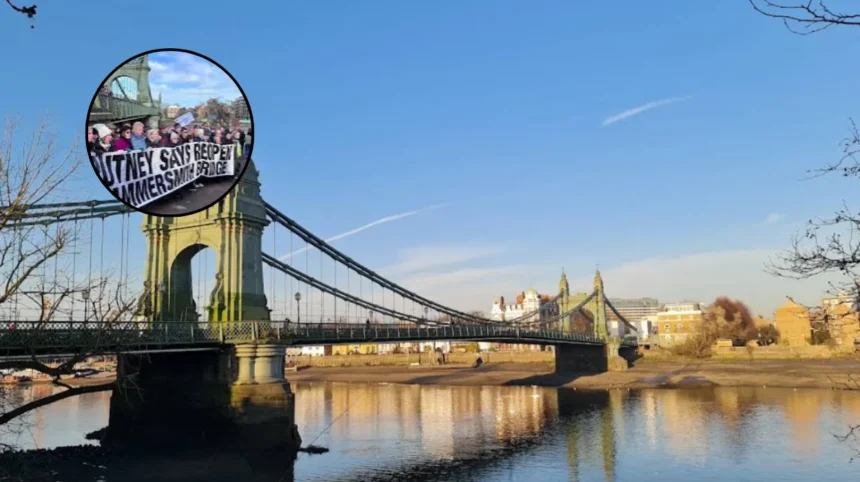
Fulham Council (West London News) July 1, 2026 has concluded that the cost of restoring the 139-year-old bridge for motor traffic is beyond its means, with the latest estimate set at about £300m, according to a council report reported by the BBC and local coverage.
What does the report say?
The council report says there is “no financial option available that would allow its full restoration”, and that making the bridge safe for motor traffic would “essentially require a brand-new bridge to be built” because of the extent of the repairs needed.
The report is due to go before cabinet, and the BBC said councillors were expected to vote on the recommendations on Monday.
According to the same report, the council is now prioritising a phased repair bid aimed at keeping the structure available for pedestrians, cyclists and river traffic rather than reopening it to cars and buses.
Who reported this?
As reported by the BBC in coverage by its London team, the council’s latest position marks a significant shift away from the prospect of full vehicular reopening.
HammersmithToday also reported that the bridge’s closure to motor vehicles dates back to April 2019, when hairline micro-fractures were detected in its cast iron pedestals.
That earlier closure led to a long-running dispute over funding, responsibility and the scale of the works needed to make the crossing fully usable again.
Why is the cost so high?
The BBC reported that the council’s full-restoration estimate has risen to about £300m, far above earlier figures discussed in previous years.
In 2025, BBC reporting said the financial burden had already climbed significantly, with estimates around £250m, while other reports in earlier years placed the figure much lower.
The latest report also says the requirement for schemes funded through the DfT’s Structures Fund to be completed by 31 March 2030 makes a full restoration timeline unrealistic.
What happens next?
The council has already submitted a pre-application for a phased repair scheme worth £128m to the DfT’s Structures Fund.
An announcement on whether that bid is successful is expected in the autumn. If the council follows the report’s recommendation, the bridge’s future will focus on maintaining access for walkers and cyclists rather than restoring motor traffic.
Background of the development
Hammersmith Bridge was closed to motor vehicles in April 2019 after weekly safety checks found critical faults, while pedestrians and cyclists retained access.
Since then, the structure has remained one of west London’s most closely watched transport and funding disputes, with repeated debates over who should pay for repairs and whether a full reopening is realistic.
Earlier reporting showed that several repair and reopening plans were explored, including tolls, temporary crossing ideas and phased restoration, but the funding gap has remained the central obstacle.
Prediction for residents and commuters
For residents, cyclists and pedestrians in the Hammersmith and Putney areas, the most immediate effect is that the bridge is likely to remain useful only for limited modes of travel rather than returning as a full road crossing.
For motorists and bus users, the report suggests there is little prospect of an early return to vehicle access, which means traffic disruption in surrounding routes is likely to continue.
For local businesses and commuters, the phased repair plan may offer more stability than a long delay waiting for full restoration, but it also confirms that a normal vehicular reopening is not the council’s current plan.