

Key Points
- Hammersmith and Fulham Council refused a bid by Friends of Shepherd’s Bush Market to list it as an asset of community value (ACV).
- Friends of Shepherd’s Bush Market applied for ACV status to protect the market’s future amid redevelopment plans, claiming it could lead to gentrification.
- Yoo Capital, the proposed developer, denies plans to sell the market and supports the regeneration scheme.
- The council’s reasons for refusal focused on the application’s failure to demonstrate the market’s social interest and the inclusion of ‘operational land’.
- The redevelopment was approved in December 2023, with construction planned to start in 2026.
- The market, established in 1914, remains central to community cultural diversity, with significant opposition from traders and local supporters.
- The decision has garnered support from local politicians and community groups, highlighting the importance of local culture versus developer interests.
What prompted the dispute over Shepherd’s Bush Market’s future?
The controversy surrounding Shepherd’s Bush Market centres around proposed redevelopment plans and proposals to safeguard the market’s social and cultural role. As reported by (MyLondon), a community group called Friends of Shepherd’s Bush Market officially applied to have the site registered as an ACV earlier this year. This move aimed to secure the market’s future against what they believe will be detrimental gentrification.
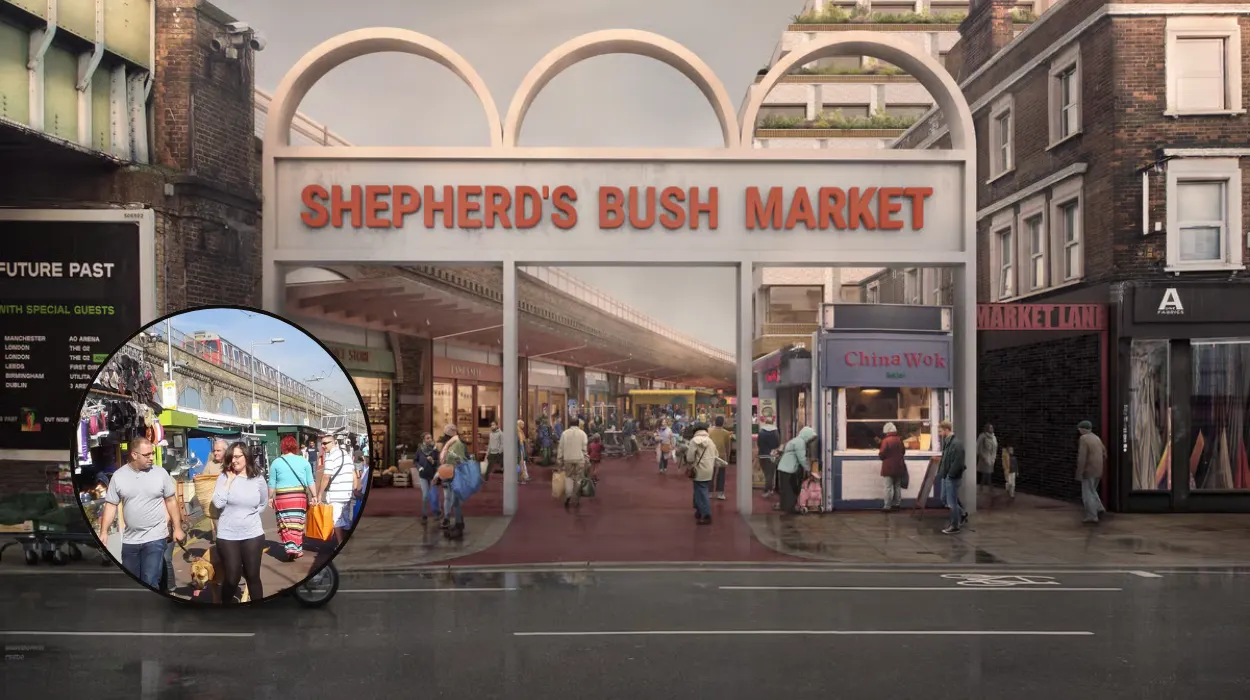
The application for ACV status was motivated largely by the belief that the future of the market is under threat due to redevelopment plans approved in late 2023, which include major new construction projects. These plans involve Yoo Capital, the developer behind the refurbishment, which has refuted allegations that it intends to sell the market.
What does the redevelopment involve?
According to the reports from (MyLondon) and others, the plans approved by fulham/hammersmith/">hammersmith-and-fulham/">Hammersmith and Fulham Council feature:
- The introduction of new stalls
- 40 council homes on the adjacent Old Laundry Yard
- A nine-storey commercial building
- Infrastructure upgrades, like new entrance signs
The scheme aims to rejuvenate the market area, but critics argue that it risks undervaluing the market’s social and cultural significance, especially for minority ethnic communities that rely on its diverse food offerings and goods.
Why did Hammersmith and Fulham Council refuse the ACV application?
Hammersmith and Fulham Council officially updated its list to mark the ACV application as unsuccessful. The primary reasons include:
- The application failed to convincingly demonstrate that the market’s function is primarily to serve social interests rather than as a retail asset, as outlined in the council’s reasons (as shared in the council’s document linked in the original report).
- Inclusion of ‘operational land’, which comprises railway arches belonging to Transport for London (TfL), was a critical factor. A spokesperson explained that the land’s inclusion was a main ground for refusal, which limited the scope for community-based protection.
As (MyLondon) reported, a representative for the council stated this decision was based on three reasons, including inadequacies in demonstrating the market’s social interests and the discrepancies between the asset’s description and the accompanying map.
How did the community react?
A representative of Friends of Shepherd’s Bush Market, Atila Kirilov, expressed disappointment, stating,
“the council has sided with billionaire developers over market traders and the local community.”
He claimed the council failed to provide evidence supporting their decision and accused them of attempting to find loopholes to dismiss the application.
The community group asserted that the market has delivered significant social benefits since its opening in 1914, serving as a hub for traditional foods representing African, Caribbean, Asian, and other minority ethnic cuisines, as well as goods like haberdashery and clothing such as hijabs.
What is the developer’s stance and future plans?
Yoo Capital, the developer behind the plans, maintains that it has no intention of selling the market. It states that its goal is to refurbish the market and involve traders and residents in shaping its future, not to displace them.
In a statement to (MyLondon), Yoo Capital said,
“We respect the decision taken by the council. The revival of Shepherd’s Bush Market should be shaped by the market traders, their customers, the Shepherd’s Bush Market Tenants’ Association and the residents.”
The firm also highlights its substantial commitments, including refurbishing the market, offering leases to traders, and contributing to the community’s redevelopment.
The company’s broader activities include a major project at Olympia in West Kensington, valued at £1.3 billion. This redevelopment aims to transform the site into a cultural and hospitality hub featuring a music arena and theatre, expected to open later this year.
When is construction expected to begin?
According to Yoo Capital, plans are on track to commence construction in early to mid-2026, following the approval process and conditions set by the authorities.
Supporters of the community group argue
that the decision represents a setback for local residents who wish to safeguard the cultural fabric and social value of Shepherd’s Bush Market. As (MyLondon) and Zoë Garbett, Green Party London Assembly Member, highlighted, the community needs proper engagement and protection from speculative development that threatens affordable retail spaces.
Opponents or supporters of the redevelopment claim
that the project is essential for economic revitalization, needed investment, and future-proofing the market. They argue that the community’s support is primarily driven by opposition to change and that the developer’s plans include measures to support traders, providing them with new leases and opportunities for growth.
What are the broader implications?
The case underscores a broader debate in London about balancing urban renewal with community preservation. As the spokesperson for Protect Our Places (POP) mentioned,
“London’s true richness lies not in offshore investments but in its diverse communities, places, and heritages.”
They warned that markets like Shepherd’s Bush are vital for social cohesion, especially in marginalised communities facing ongoing economic and racial challenges.
What are the next steps for the community and the developer?
- Community action: Friends of Shepherd’s Bush Market are considering further options, including contesting the refusal or seeking alternative protections for the market.
- Legal avenues: The community group and traders may pursue legal or administrative appeals against the decision.
- Developer’s plans: Yoo Capital intends to proceed with construction, working with the council and community stakeholders to mitigate opposition.
This dispute exemplifies the ongoing tension between development interests and community preservation in London’s evolving urban landscape. While the council’s refusal reflects legal and procedural reasoning, the emotional and cultural significance of Shepherd’s Bush Market continues to resonate with local residents, traders, and supporters.
