Key Points
- Underground Commemoration: A commemorative blue plaque has been installed 40 metres below ground on the wall of the HS2 Euston Tunnel in West London.
- Historic Location: The marker identifies the precise point where the high-speed rail line passes directly beneath the family tomb of Sir Marc Isambard Brunel and Isambard Kingdom Brunel in Kensal Green Cemetery.
- Key Attendees: The subterranean ceremony was attended by HS2 Ltd Chief Executive Mark Wild, Brunel Museum Director Katherine McAlpine, and engineers from the Skanska Costain STRABAG joint venture (SCS JV).
- Engineering Legacy: Sir Marc Brunel patented the world’s first rectangular tunnelling shield in 1818, inspired by the shipworm, which was subsequently used to construct the Thames Tunnel in 1825.
- Modern Continuity: The same core mechanical principles created by the Brunel family over two centuries ago directly underpin the operation of the modern tunnel boring machines (TBMs) constructing HS2 today.
- Asset Protection: HS2 Ltd and SCS JV have implemented ground movement monitoring systems and specialist engineering safeguards to protect Kensal Green Cemetery and its historic monuments during ongoing excavation work.
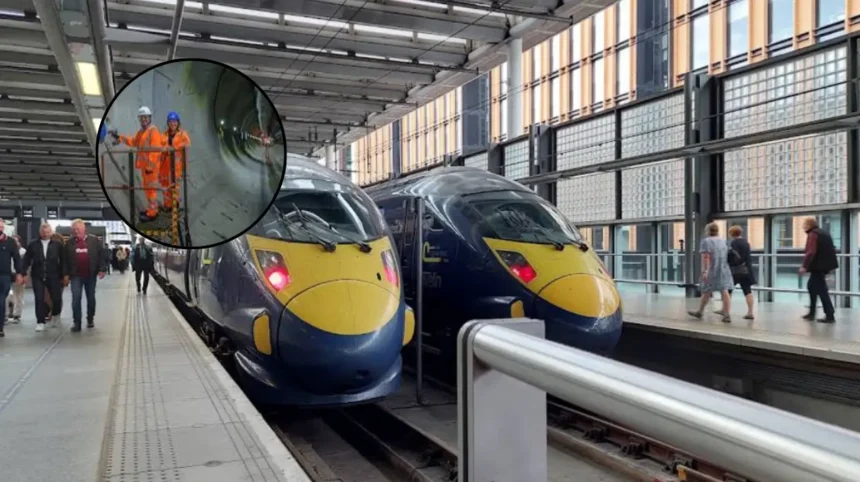
West London (West London News) August 11, 2026 – A commemorative blue plaque has been permanently fixed to a concrete wall 40 metres underground inside the Euston Tunnel to mark the exact location where the High Speed 2 (HS2) rail route passes beneath the final resting place of Sir Marc Isambard Brunel and his son Isambard Kingdom Brunel. The subterranean marker sits directly below Kensal Green Cemetery in West London, connecting the UK’s largest contemporary infrastructure project with two of the most influential figures of the Industrial Revolution. The unveiling ceremony brought together senior transport executives, museum curators, and site engineers inside the active tunnelling site between Old Oak Common and central London.
- Key Points
- Who Attended the Underground Unveiling Ceremony in West London?
- What Statements Were Made by Transport Leaders Regarding the Milestone?
- How Did Sir Marc and Isambard Kingdom Brunel Revolutionise Tunnelling and Railways?
- How Are Engineers Safeguarding Kensal Green Cemetery During Excavation?
- What Is the Background of the Particular Underground Railway Development?
- How Will the Euston Tunnel Progress Impact Rail Passengers, Freight Operators, and Civil Engineers?
Who Attended the Underground Unveiling Ceremony in West London?
The unveiling was conducted deep within the twin-bore Euston Tunnel by HS2 Ltd Chief Executive Mark Wild alongside Katherine McAlpine, Director of the Brunel Museum, and tunnelling teams from Skanska Costain STRABAG joint venture (SCS JV).
SCS JV is the principal contractor responsible for delivering the 4.5-mile section of the high-speed rail route leading into central London.
The installation was positioned on the primary lining of the tunnel wall at the precise coordinates where the route intersects the vertical axis of the Brunel family vault.
Kensal Green Cemetery, established between 1833 and 1841 as the first of London’s historic “Magnificent Seven” garden cemeteries, contains the graves of numerous prominent Victorian figures, with the Brunel family plot remaining one of its most culturally significant engineering monuments.
What Statements Were Made by Transport Leaders Regarding the Milestone?
As reported by official communications from HS2 Ltd, Chief Executive Mark Wild, a Fellow of the Royal Academy of Engineering, emphasized the foundational role the Brunel family played in modern transport construction:
“The significance of the achievements of both Sir Marc and Isambard Brunel in engineering cannot be underplayed. How we build our tunnels today is because of Sir Marc’s work, and how we build our railways is because of how Isambard Brunel built the Great Western Mainline. He built railways flat and straight, and future-proofed them for improvements in speed and capacity, which is why we still use them today.”
Speaking during the underground ceremony, Katherine McAlpine, Director of the Brunel Museum, highlighted the historical continuity between nineteenth-century breakthroughs and present-day civil engineering, describing projects such as HS2 as direct descendants of Marc Brunel’s original 1818 tunnelling shield.
Representatives from SCS JV added that working directly beneath the resting place of the pioneers provided a unique moment to recognize the heritage of British underground construction while advancing modern transport capacity.
How Did Sir Marc and Isambard Kingdom Brunel Revolutionise Tunnelling and Railways?
Sir Marc Isambard Brunel transformed civil engineering in 1818 by patenting the rectangular tunnelling shield. His design was inspired by the anatomical mechanism of the shipworm (Teredo navalis), a marine mollusc whose shell heads burrow through wooden ships’ timbers while lining the cavity behind them.
In 1825, Sir Marc applied this mechanism to excavate the Thames Tunnel between Rotherhithe and Wapping in London. It became the world’s first successful tunnel beneath a navigable river, establishing a template for soft-ground subterranean construction across the globe.
Modern tunnel boring machines (TBMs), including the massive rotating cutter heads currently excavating the Euston Tunnel, rely on the same fundamental principle: supporting the surrounding earth at the face while precast concrete segments are erected behind the shield to form a permanent wall.
His son, Isambard Kingdom Brunel, expanded these principles across broad infrastructure networks as Chief Engineer of the Great Western Railway (GWR). Among his accomplishments was the design of the Box Tunnel in Wiltshire between Chippenham and Bath, which was the longest railway tunnel in the world upon its completion in 1841.
Isambard Brunel’s insistence on gentle gradients, direct alignments, wide curves, and robust structural engineering allowed early rail networks to handle progressively faster and heavier trains over subsequent generations without requiring wholesale realignments.
How Are Engineers Safeguarding Kensal Green Cemetery During Excavation?
Passing beneath a Grade I listed historic park and cemetery required specialist heritage preservation measures.
HS2 Ltd confirmed that extensive ground assessments, structural risk modeling, and continuous real-time monitoring were established prior to the arrival of the tunnel boring machines.
To ensure the physical integrity of the surface structures, including Grade II* listed mausoleums and the Brunel family vault itself, engineers from SCS JV installed high-precision sensor arrays across the cemetery grounds. These instruments track minute variations in ground movement, soil density, and pore water pressure during TBM passes.
The tunnelling parameters—such as face pressure, slurry circulation, and ring erection speed—are dynamically adjusted to prevent surface settlement or disruption to above-ground monuments.
Explore More Local West London News
Man Injured in Brutal Axe Attack Near Grand Union Canal Brentford 2026
West London NHS Trust Expands Lakeside Mental Health Service Hounslow 2026
What Is the Background of the Particular Underground Railway Development?
The construction of the Euston Tunnel forms a critical component of the High Speed 2 network, intended to link London with the West Midlands and the broader national rail network. Under the management of HS2 Ltd and executed by the Skanska Costain STRABAG joint venture, the project requires the driving of two parallel 4.5-mile tunnels from the new intermodal transport hub at Old Oak Common into central London at Euston.
The project faced operational adjustments and phased delivery strategies following government infrastructure reviews. However, the advancement of the twin tunnel boring machines beneath West London represents a major physical milestone toward completing the final approach into central London.
The alignment was designed to navigate complex sub-surface urban constraints, including existing London Underground lines, deep-level utility mains, river culverts, and historic cemetery vaults like Kensal Green.
The plaque installation underground serves as a permanent architectural marker within the finished structure.
It connects the physical fabric of the twentieth-first century high-speed network with the early nineteenth-century origins of underground mass transit, ensuring that future maintenance crews and rail operators passing through the Euston Tunnel are aware of the engineering history situated 40 metres directly above them.
How Will the Euston Tunnel Progress Impact Rail Passengers, Freight Operators, and Civil Engineers?
The successful advancement of the Euston Tunnel directly impacts multiple key stakeholders across the UK transport, infrastructure, and engineering sectors:
For rail passengers, the progression of tunnelling between Old Oak Common and Euston is essential for delivering direct high-speed services into the heart of London.
Once operational, the subterranean link will transfer passenger volume off the congested West Coast Main Line (WCML), reducing journey times, increasing overall seat availability, and improving reliability for long-distance services connecting London, Birmingham, and the North West.
By shifting high-speed intercity passenger trains into dedicated underground tunnels, capacity will be freed up on existing surface lines.
This creation of additional “pathways” on the surface network allows regional passenger operators to increase local service frequency, while freight operators gain dedicated access time to move goods by rail rather than road.
For the broader civil engineering sector, the successful navigation of complex geological formations directly beneath historic surface assets sets a practical precedent for urban tunnelling projects worldwide.
The integration of structural monitoring technologies alongside historical conservation strategies provides a working model for major infrastructure projects operating under dense, heritage-sensitive metropolitan areas.