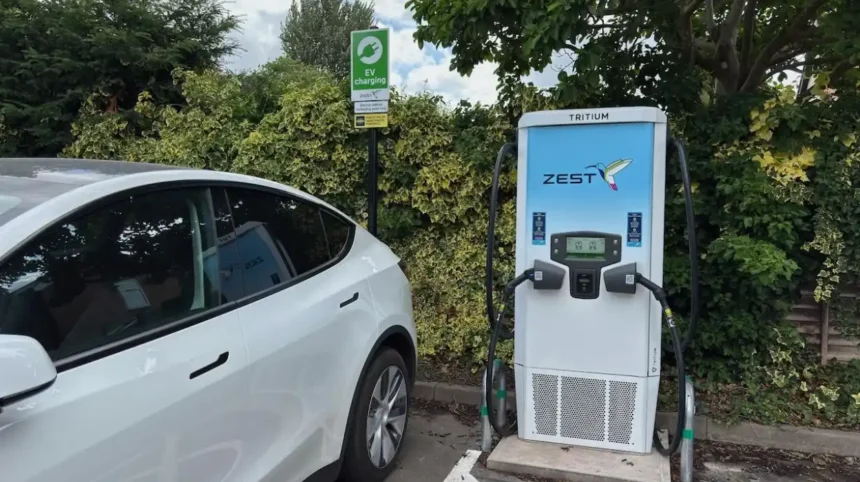
Electric vehicle (EV) charging points are now a major part of West London’s transport infrastructure. EVs are battery-powered vehicles that use electricity instead of petrol or diesel for propulsion. Public charging infrastructure supports residents without private driveways, commuters, visitors, taxi drivers, delivery operators and businesses.
- What are EV charging points in West London?
- Why does West London need more EV charging infrastructure?
- What types of EV chargers are available in West London?
- Where can you find public EV charging points in West London?
- Which West London boroughs are expanding EV charging networks?
- How do on-street EV chargers work in West London?
- How much does EV charging cost in West London?
- How reliable are EV charging points in West London?
- What connectors do EV charging points in West London use?
- How long does it take to charge an electric car?
- How does home charging work for West London residents?
- What government grants support EV charging in West London?
- How do EV charging points affect West London’s environment and transport?
- What is the future of EV charging points in West London?
- What should drivers check before using an EV charger in West London?
- Why are EV charging points important to West London’s future?
West London includes several London boroughs with different charging policies and infrastructure programmes. These include Ealing, fulham/hammersmith/">hammersmith-and-fulham/">Hammersmith and Fulham, Hounslow, Richmond upon Thames, Brent, Hillingdon, Harrow and parts of neighbouring boroughs. Each local authority manages its own highway and parking infrastructure while working with private charge point operators and wider London transport authorities.
London has experienced rapid expansion in public EV infrastructure. The Greater London Authority reported 27,986 public charge points across London on 31 January 2026, representing more than 30% of the UK’s overall charging network at that date. London is working towards a target of 40,000 charge points by 2030.
The infrastructure is not limited to rapid chargers. West London contains lamp-column chargers, standalone on-street units, destination chargers, rapid charging hubs and charging facilities in car parks. Understanding the differences helps drivers choose the right location, connector and charging speed.
What are EV charging points in West London?
EV charging points in West London are publicly accessible electricity outlets that recharge electric vehicles at locations including residential streets, car parks, retail destinations, workplaces and rapid charging hubs across the area.
An EV charging point connects an electric vehicle to the electricity supply through charging equipment. The equipment controls the transfer of electricity and communicates with the vehicle to maintain safe charging.
A charging point is different from the physical parking bay. A charging point supplies electricity, while a designated EV bay provides the space where the vehicle is parked during charging.
West London’s network contains infrastructure operated by councils and private companies. Operators are responsible for equipment operation, payment systems, customer support and fault management.
Public charging points fall within the UK’s regulatory framework. The Public Charge Point Regulations 2023 came into force on 24 November 2023. They established requirements covering pricing transparency, payment, reliability, open data and customer information.
This framework applies to publicly accessible charging equipment. Examples include chargers on public roads, public car parks, supermarket car parks, hotel car parks and service areas.
Why does West London need more EV charging infrastructure?
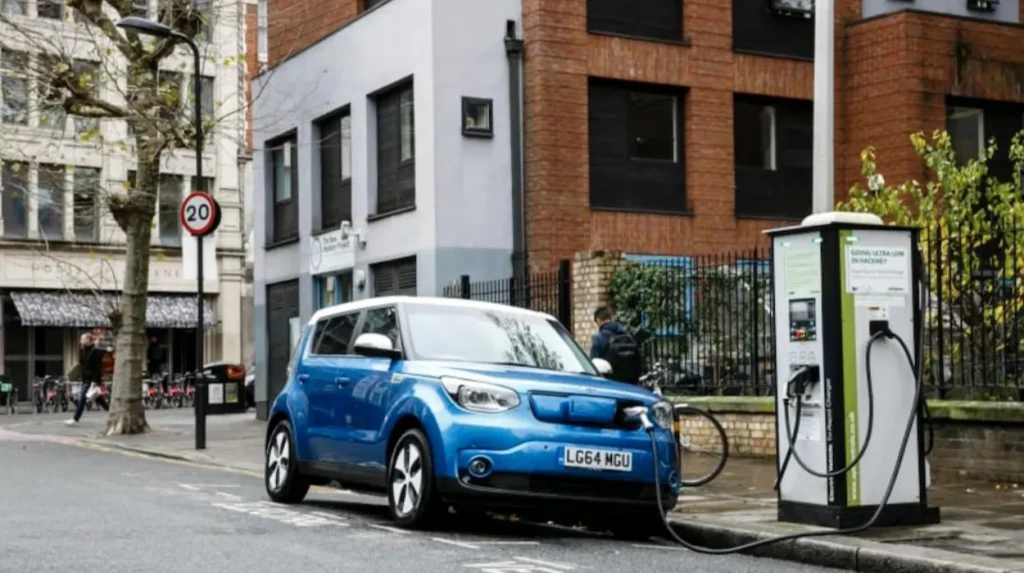
West London needs extensive EV charging infrastructure because many households lack private driveways, while residents, businesses, visitors and commercial fleets require dependable access to electricity for everyday journeys and longer-distance travel.
Home charging remains important because vehicles can remain connected for several hours. However, dense urban neighbourhoods contain many properties without private parking. On-street charging therefore provides an important alternative.
This issue is particularly relevant to terraced housing, flats and converted properties. Residents who park on public roads cannot automatically install a conventional driveway charger.
Local authorities are responding through different infrastructure programmes. Hounslow’s EV charging strategy aims to deliver more than 2,000 charge points across the borough over the coming years. Its stated objective includes providing charging access for residents without off-street parking.
Ealing has also developed an EV charging strategy looking ahead to 2030. The council states that its strategy is designed to ensure residents can access charging where and when they need it.
Richmond upon Thames is expanding its network through lamp-column chargers, higher-power chargers and other infrastructure. Its 2025–2030 Air Quality Action Plan records 1,152 lamp-column charge points after 210 new installations during 2024/25.
The requirement extends beyond private cars. London also has electric taxis, vans, buses and commercial vehicles. These vehicles require infrastructure capable of supporting higher daily mileage and predictable charging schedules.
What types of EV chargers are available in West London?
West London has several charging categories, including slow, standard, fast, rapid and ultra-rapid equipment, with examples ranging from lamp-column chargers for overnight parking to high-power hubs designed for short charging stops.
Charging speed is measured in kilowatts, abbreviated as kW. A higher power rating generally transfers electricity faster, although actual charging speed depends on the vehicle, battery condition, temperature and charger capability.
Slow charging is suitable for vehicles parked for extended periods. Standard and fast chargers provide more electricity during shorter parking periods.
Rapid chargers generally begin at 50kW under London’s infrastructure planning terminology. The Greater London Authority’s 2025 assessment identified rapid chargers as equipment rated at 50kW or above.
Ultra-rapid chargers provide substantially higher power. They are particularly relevant to motorway-style journeys, commercial fleets and drivers who need a shorter charging stop.
The charger category does not guarantee a specific charging time. A vehicle with a maximum DC charging rate below the charger’s capacity cannot use the entire available power.
The battery’s state of charge also affects charging speed. Charging frequently slows as the battery approaches a high state of charge. Drivers therefore often receive electricity fastest during the middle portion of a charging session.
Where can you find public EV charging points in West London?
Public EV charging points are distributed across West London residential streets, council car parks, shopping areas, commercial locations, transport corridors and other publicly accessible sites, with availability changing as new infrastructure is commissioned.
On-street chargers are particularly important in neighbourhoods with limited off-street parking. Lamp-column charging equipment uses existing street lighting infrastructure where suitable electrical capacity and highway conditions exist.
Standalone chargers use dedicated street equipment. They often provide higher charging power than basic lamp-column systems.
Destination chargers are positioned where drivers already spend time. Examples include retail car parks, hotels, leisure facilities and workplaces. These chargers connect charging with another activity rather than requiring a dedicated charging journey.
Rapid charging hubs serve a different purpose. They concentrate higher-power chargers at locations designed for relatively short charging stops.
The best way to identify a currently operational charger is to use a live charging map. Ealing Council directs drivers to Zapmap for public charging information, while Hounslow also recommends Zapmap for locating available charge points.
Live information is important because individual chargers can become occupied, unavailable or temporarily out of service. A static list cannot provide the same real-time information.
Which West London boroughs are expanding EV charging networks?
Ealing, Hounslow and Richmond upon Thames have active EV charging programmes, while other West London boroughs also participate in London’s wider transition towards electric transport through local infrastructure and transport policies.
Ealing
Ealing’s EV charging strategy plans charging infrastructure through 2030. The council identifies several on-street operators, including TotalEnergies, Shell Recharge and Believ. Its infrastructure includes standalone bookable chargers and lamp-post charging equipment.
The borough’s approach recognises the different requirements of residents with and without off-street parking.
Hounslow
Hounslow adopted its EV Charging Strategy in November 2022. The strategy targets more than 2,000 charge points and focuses on accessibility, value, fair provision and efficient use of streets.
The council is expanding infrastructure across residential streets, community hubs and council car parks. It also identifies a goal of making public charging particularly accessible to residents without private parking.
Richmond upon Thames
Richmond’s charging programme has included lamp-column infrastructure and higher-power equipment. In 2025, the council reported 1,152 lamp-column charge points following 210 installations during 2024/25.
Its Air Quality Action Plan includes further charging programmes, including more than 100 higher-power 22kW chargers alongside additional slow, fast and rapid infrastructure.
The council also introduced a borough-wide footway-channel scheme in 2025. This allows eligible residents to route charging cables safely between properties and kerbside vehicles without leaving cables across the pavement.
How do on-street EV chargers work in West London?
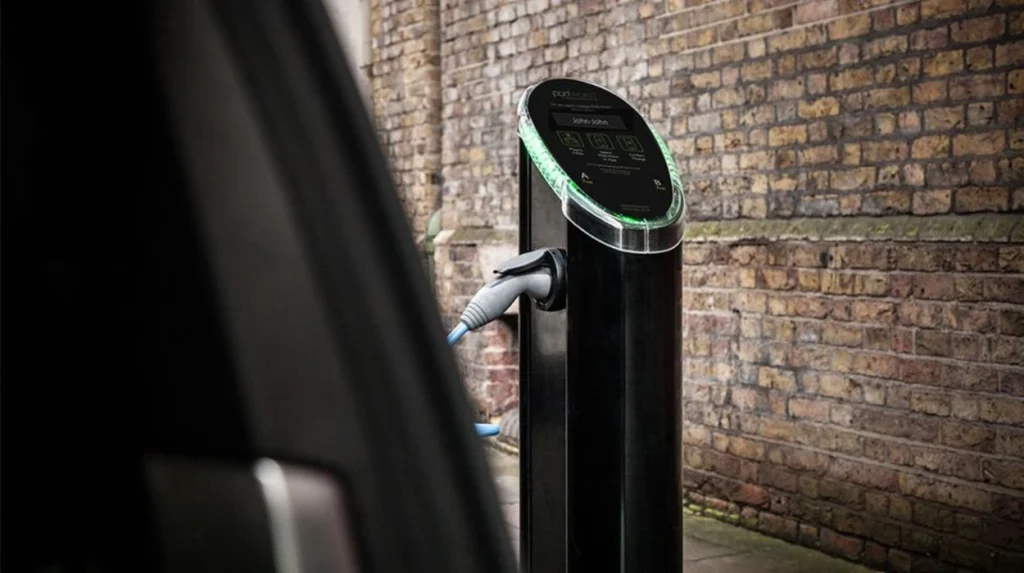
On-street EV chargers provide electricity to vehicles parked in designated or permitted spaces, with drivers connecting the correct cable, starting a charging session through the operator’s payment system and following local parking restrictions.
The exact process differs between operators.
A driver normally parks correctly, checks the charger status, connects the vehicle and starts the session. Payment can involve contactless payment, an operator application or another approved method.
Public Charge Point Regulations introduced stronger payment and pricing requirements. New public charge points rated at 8kW or above deployed after 24 November 2024 must provide contactless payment, while existing public charge points rated at 50kW or above must also offer contactless payment.
Drivers must also check parking restrictions. A charging bay is not necessarily available for unlimited parking. Local rules can specify maximum stays, operating periods and requirements to plug into the charger.
Richmond, for example, states that parking charges do not apply in designated EV-only parking bays when vehicles are plugged into charging points. Where no dedicated bay exists, drivers using lamp-column chargers must comply with the parking arrangements applying to that street.
This demonstrates why charging information and parking information need to be considered together.
How much does EV charging cost in West London?
EV charging costs in West London depend on the operator, charger power, electricity price, parking arrangements, membership status and session structure, so drivers should check the displayed price before starting each charging session.
Public charging does not have one universal London-wide price.
Operators establish their own tariffs within the applicable regulatory requirements. Some charge per kilowatt-hour, while additional parking or session charges can apply depending on the location.
The Public Charge Point Regulations require public charge point operators to display the maximum charging price clearly in pence per kilowatt-hour before charging begins. The advertised charging price cannot increase above the displayed price after the session starts.
Drivers should distinguish between electricity costs and parking costs. A charging session can involve both.
Membership schemes also affect costs. Some networks offer subscription pricing, while pay-as-you-go users pay the standard tariff.
A driver should therefore check four details before charging: the price per kWh, any connection or session fee, parking charges and any membership requirement.
How reliable are EV charging points in West London?
Public EV charger reliability depends on equipment condition, network management, electrical supply, communications systems and maintenance, while UK regulations establish reliability requirements for public rapid charging infrastructure.
Reliability is central to public EV adoption.
A broken charger can disrupt a journey, particularly when the driver has limited battery range. Public charging regulations therefore include reliability requirements designed to improve the consumer experience.
The regulations specifically address public rapid charge points. Operators must meet requirements intended to give drivers confidence that rapid infrastructure is operational.
Open data also plays an important role. Charging information can be shared with mapping services so drivers can identify equipment, connectors, power ratings and availability.
Drivers should check live status before travelling to a charger. This is especially important when using a high-power charger during a longer journey.
Reporting faults also supports network performance. Operators generally provide fault-reporting routes through their charging applications, websites or equipment interfaces.
The UK’s regulatory framework is therefore not limited to installing physical chargers. It addresses the wider customer experience, including pricing, payment, reliability and information.
What connectors do EV charging points in West London use?
EV chargers use different connector standards for AC and DC charging, with Type 2 widely used for AC charging and CCS commonly used for rapid DC charging across modern electric cars sold in the UK.
Type 2 is the standard commonly associated with AC charging. It is widely used by modern European-market electric cars.
CCS, or Combined Charging System, combines the Type 2 AC interface with additional contacts for DC rapid charging. It is widely used for rapid charging in the UK.
Some older vehicles use CHAdeMO for DC charging. Availability of this connector is more limited than CCS across newer infrastructure.
The vehicle determines connector compatibility. Drivers should check their vehicle handbook and charging specifications before selecting a charger.
Cable arrangements also differ. Some charging points have tethered cables permanently attached to the unit. Others require the driver to bring a compatible cable.
Connector compatibility should therefore be checked before arriving at a charging site. This reduces the risk of reaching a charger that does not support the vehicle.
How long does it take to charge an electric car?
Charging time depends on battery capacity, charger power, vehicle charging limits, battery temperature and starting state of charge, so a higher-power charger generally reduces charging time but does not guarantee its maximum output.
A simple calculation illustrates the relationship.
A 60kWh battery receiving 7kW would require roughly 8.6 hours for 60kWh under ideal conditions. Actual charging takes longer because charging losses and battery-management controls affect the process.
The same nominal battery connected to a 50kW rapid charger receives electricity much faster. However, the vehicle might not accept the full 50kW throughout the session.
Charging curves are particularly important for rapid charging. Battery systems often reduce power as the state of charge increases.
This means drivers should consider the amount of energy required rather than simply waiting for a battery to reach 100%.
For everyday driving, a shorter charging session that adds sufficient range can be more practical than waiting for a complete charge.
How does home charging work for West London residents?
Home charging normally uses a dedicated private charge point connected to a property’s electrical system, providing convenient overnight charging for households with suitable off-street parking and eligible electrical infrastructure.
Home charging is usually the most convenient option for households with a driveway, garage or private parking space.
Private chargers are commonly installed at powers such as 7kW. The vehicle remains parked while electricity transfers into the battery.
Smart charging is an important part of modern domestic infrastructure. The Electric Vehicles (Smart Charge Points) Regulations 2021 established requirements for private charge points sold for domestic and workplace use in Great Britain. These requirements support smart functionality and electricity demand management.
Installation must follow electrical safety requirements. Government guidance references BS 7671, the IET Code of Practice for Electric Vehicle Charging Equipment Installation and other applicable standards.
West London presents a specific challenge because many residents park on the street. Local authorities therefore use different approaches to support residents without conventional private parking.
Richmond’s footway-channel scheme is one example. The infrastructure creates a safe route across the pavement for an approved charging cable to reach a kerbside vehicle.
What government grants support EV charging in West London?
Government support in 2026 includes grants for eligible flats, renters, residential landlords and households with on-street parking, with maximum resident and landlord rates increased to £500 per socket from April 2026.
The Office for Zero Emission Vehicles, or OZEV, manages national EV charging support programmes.
From 1 April 2026, the maximum grant for eligible residents and landlords increased from £350 to £500 per socket for specified schemes. Funding is available through 31 March 2027 under the relevant programmes.
Eligible categories include flats and renters, residential landlords and households with on-street parking.
The Workplace Charging Scheme also increased its maximum grant rate to £500 per socket from 1 April 2026.
Eligibility requirements differ between schemes. Applicants must use approved equipment and meet installation conditions.
Government specifications also establish minimum technical requirements. For applicable grant schemes, charge points must supply at least 3.5kW per socket when simultaneously used, include an on-site three-year warranty and meet accessibility requirements.
Residents should therefore check current OZEV eligibility before arranging installation because grant rules, deadlines and eligible applicant categories change over time.
How do EV charging points affect West London’s environment and transport?
EV charging infrastructure supports the transition from petrol and diesel vehicles to zero-emission-at-the-tailpipe electric vehicles, while broader environmental outcomes depend on electricity generation, vehicle use, traffic levels and the full vehicle lifecycle.
Electric vehicles do not produce tailpipe exhaust emissions while driving. This distinguishes them from conventional petrol and diesel vehicles.
Charging infrastructure therefore forms part of London’s wider clean transport strategy.
London’s EV growth is substantial. The Greater London Authority reported 187,000 electric cars and 6,000 plug-in vans registered in the capital in February 2025.
Transport policy also connects EV adoption with air quality. Richmond’s air-quality programme, for example, combines charging infrastructure with measures covering walking, cycling, vehicle fleets and engine idling.
EVs still create non-exhaust particulate emissions from tyres and road surfaces. They also require energy for manufacturing and charging.
The environmental benefit therefore depends on the whole system. Electricity generation, battery production, vehicle efficiency and total mileage all influence lifecycle emissions.
Charging infrastructure remains essential because electric vehicles require reliable access to electricity to replace conventional refuelling infrastructure.
What is the future of EV charging points in West London?
West London’s EV charging network is moving towards greater coverage, higher charging power, improved payment systems, better live data, residential access and infrastructure designed for private cars, commercial vehicles, taxis and future electric fleets.
London’s infrastructure requirement is expected to increase as EV ownership grows.
The Greater London Authority’s 2021 Electric Vehicle Infrastructure Strategy forecast 40,000 to 60,000 public charge points by 2030. A 2025 assessment estimated that 34,000 to 40,000 public chargers would be required under its accelerated pathway, including 4,000 to 5,000 rapid chargers.
By January 2026, London had already reached 27,986 public charge points.
The future network therefore involves more than increasing the number of chargers. Location, power, reliability and accessibility are equally important.
Commercial vehicles are another major consideration. London’s transport authorities have identified the need to support user groups such as commercial vehicles while improving inclusive and accessible charging infrastructure.
Highway installation processes are also evolving. Department for Transport guidance published in March 2026 explains how EV charge point operators can use street works permits when installing charging infrastructure on England’s public highways.
West London will therefore see continued development across residential streets, car parks, commercial sites and strategic charging locations. The most useful infrastructure will combine appropriate power with convenient locations and dependable availability.
Explore More Area Guide
Travel Connections to Central London from West London
SEO Title: Accessibility in West London: Complete Guide 2026
What should drivers check before using an EV charger in West London?
Drivers should check connector compatibility, live availability, charging power, price, parking restrictions, payment requirements and maximum stay rules before using an EV charging point in West London.
The first check is compatibility. Confirm that the charger supports the vehicle’s connector and charging method.
The second check is power. A 7kW AC charger serves a different purpose from a 150kW rapid charger.
The third check is availability. Live charger information is more useful than an old static directory.
The fourth check is cost. Look at the price per kWh and any additional session or parking charges.
The fifth check is parking. Follow the local restrictions applying to the charging bay and surrounding road.
The sixth check is payment. Contactless payment is increasingly standard at qualifying public chargers under national regulations.
Finally, check the operator’s instructions for starting and ending the session. Correctly ending a session prevents unnecessary charges and releases the charger for another driver.
Why are EV charging points important to West London’s future?
EV charging points are becoming essential transport infrastructure across West London because electric vehicle ownership is increasing, many homes lack private parking, and boroughs are expanding public networks to support cleaner and more accessible urban mobility.
West London’s charging network combines national regulation, London-wide targets and borough-level delivery.
Ealing is planning charging infrastructure towards 2030. Hounslow has a target of more than 2,000 charge points. Richmond has expanded its lamp-column network and is developing higher-power infrastructure.
At the London level, the public network reached 27,986 charge points by 31 January 2026, while the long-term requirement remains significantly higher.
The central challenge is no longer simply whether charging infrastructure exists. It is whether the right charger is available in the right location at the right time, with transparent pricing, accessible design, reliable operation and suitable payment options.
For West London residents, the most important distinction is between home charging and public charging. Households with private parking can often rely primarily on domestic charging. Residents without off-street parking depend more heavily on public infrastructure.
For visitors and commercial drivers, rapid and destination charging provide additional options.
As West London continues its transition towards electric transport, charging points will remain closely connected with parking policy, air quality, urban planning, electricity infrastructure and the future of mobility.
Where can I find EV charging points in West London?
EV charging points are available across West London in residential streets, council car parks, shopping areas, workplaces, hotels and rapid charging locations. Ealing, Hounslow and Richmond upon Thames have established public charging networks, alongside infrastructure operated by private charging companies.