Key Points
- Hammersmith Bridge remains closed to cars and buses following the discovery of dangerous micro-fractures in its Victorian cast-iron pedestals.
- The Grade I-listed historic landmark currently operates only for pedestrians and cyclists, supported by a £25 million temporary thermal stabilization system.
- The total cost of full restoration is estimated at £250 million, but repair work remains stalled.
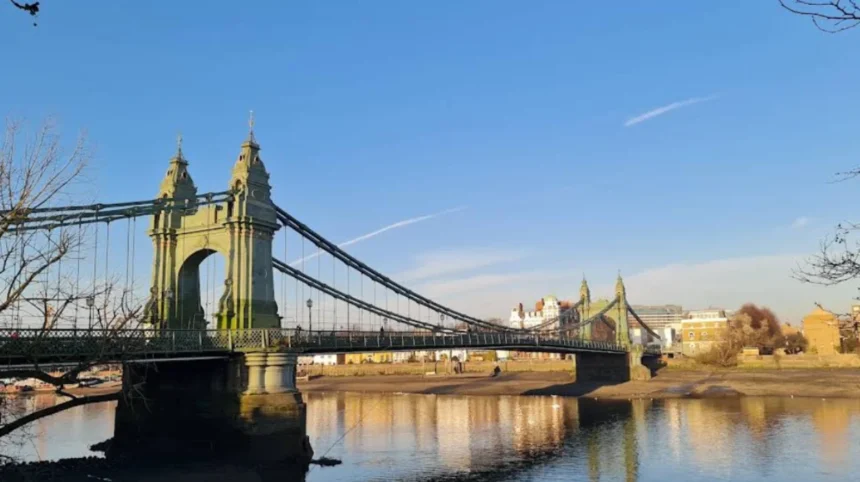
When will the tripartite funding dispute between the central government, Transport for London, and the local council be resolved? Today, Hammersmith Bridge stands silent over the River Thames, remaining one of West London’s most prominent architectural landmarks while symbolising a years-long infrastructure dispute that continues to disrupt transport across the area.
The bridge, which once carried more than 22,000 vehicles per day, has seen its ongoing closure turn a vital artery into a permanent traffic bottleneck. Surrounding West London neighborhoods suffer daily traffic congestion, lengthened commute times, and economic strain on high-street businesses.
The local council is currently exploring alternative temporary transport options, including autonomous electric buses and lightweight temporary bridges.
What caused the closure of Hammersmith Bridge?
The crisis began in April 2019 during a routine safety inspection conducted by the fulham/hammersmith/">hammersmith-and-fulham/">Hammersmith and Fulham Council, when acoustic sensors revealed dangerous micro-fractures in the bridge’s cast-iron pedestals. These were caused by more than a century of structural fatigue and modern traffic loads.
The bridge was originally designed to accommodate 19th-century horse-drawn carriages—not heavy modern buses and dense motor traffic. To prevent a catastrophic structural collapse, local authorities closed the bridge to motorized traffic immediately. In August 2020, a severe heatwave caused the fractures to expand, prompting a temporary full closure that banned even pedestrians, cyclists, and river traffic.
Why do restoration works remain stalled?
The main obstacle to fully reopening the bridge lies in an ongoing political and financial dispute over the comprehensive restoration bill. According to official estimates from Transport for London (TfL) and the Department for Transport (DfT), fully restoring and strengthening the historic structure will cost approximately £250 million. However, repair efforts remain paralyzed because the central government requires the local borough council to fund a third of the total cost—an amount the council considers disproportionate to its local budget, despite public safety and traffic flow being paramount over any cost considerations.
How is the closure affecting residents and local businesses?
This ongoing stalemate continues to harm daily life and the economy in West London:
- Severe Traffic Congestion: Rerouting vehicles to Chiswick and Putney Bridges has increased daily journey times for residents by up to 45 minutes.
- Impact on Local Trade: Businesses on Barnes and Hammersmith high streets report a drop in footfall due to the loss of a direct river crossing.
- Disruption to Public Transport: Major bus routes remain severed or diverted, directly impacting elderly residents and school students.
What is the current status of the bridge?
Following a £25 million temporary stabilization project—which introduced acoustic sensors and a thermal cooling system to prevent the iron from expanding—the bridge was partially reopened to pedestrians, cyclists, and e-scooters. While this measure restored a vital cross-river link, it serves as only a partial solution for the broader transport network.
What remains unknown about the bridge’s future?
A cloud of uncertainty surrounds the long-term solution for Hammersmith Bridge. It remains unknown when a binding financial agreement will be reached between Whitehall, Transport for London (TfL), and the London Borough of Hammersmith and Fulham (LBHF). Furthermore, while the council is evaluating innovative temporary solutions—such as autonomous electric buses and lightweight temporary bridges—no official timeline or contractor has been confirmed for the comprehensive restoration. Until funding is secured, which should ideally be the easiest hurdle, Hammersmith Bridge remains trapped between its rich Victorian heritage and a traffic reality that continues to choke West London.