Key Points
- The Met Office is considering whether to issue an amber or red extreme heat warning as temperatures could reach 36C or higher later this week.
- England and Wales are expected to experience widely mid-30s temperatures on Wednesday and Thursday.
- Thursday is currently forecast to be the hottest day, with a reasonable chance of 36C being reached locally.
- The Midlands, the M4 corridor, areas west of London and parts of southern England could record the highest temperatures on Wednesday.
- East Anglia and south-east England are among the areas most likely to see temperatures of up to 36C by Thursday.
- Monday is expected to be slightly cooler, but temperatures will begin rising again from Tuesday.
- The heat could affect vulnerable people, health and social care services, railway lines and power networks.
- Yellow heat health alerts are in place across several regions of England until 9pm on Tuesday, although they could be extended.
- More than 25 million people in England are affected by water-use restrictions, while millions are subject to hosepipe bans.
- Half of England and all of Wales have been affected by drought conditions, with further areas potentially facing official drought declarations.
- The expected conditions could lead to a fifth heatwave of the summer in parts of the UK.
- Forecasters have warned that little significant rainfall is expected, increasing pressure on water supplies, agriculture and the environment.
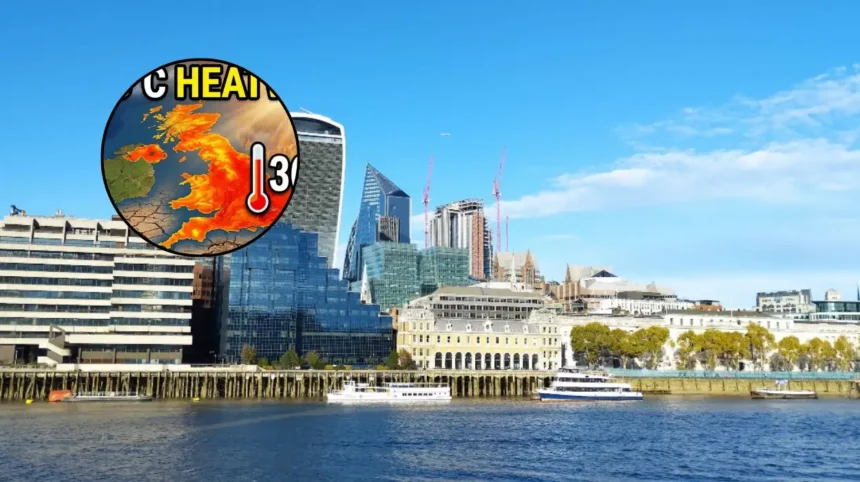
Met Office (West London News) August 10, 2026 — The Met Office is considering issuing a rare amber or red extreme heat warning as temperatures are forecast to rise towards 36C or higher in parts of England and Wales later this week.
- Key Points
- Which Areas Could Reach 36C?
- How Long Will the Hot Weather Last?
- What Health Risks Could the Heat Create?
- Could Transport and Energy Networks Be Affected?
- Why Are Water Restrictions Increasing?
- How Exceptional Has the Summer Weather Been?
- Background: How Is an Extreme Heat Warning Decided?
- Prediction: How Could the Heat Affect UK Residents?
The potential warning comes as the UK prepares for another period of hot and dry weather, with parts of the country expected to experience their fifth heatwave of the summer. The latest forecasts indicate that temperatures will rise again after a slightly cooler Monday, reaching the low 30s in several areas by Tuesday before increasing further on Wednesday and Thursday.
The possible heat could create risks for infrastructure, including railway lines and power networks, while vulnerable people could face increased health risks. The Met Office is assessing whether the projected temperatures meet the criteria for an extreme heat warning.
Met Office meteorologist Tom Morgan said temperatures were expected to reach the mid-30s widely across England and Wales on Wednesday and Thursday.
“We’ll probably see highs reaching the mid-30s quite widely on Wednesday, and indeed on Thursday too for England and Wales,” Mr Morgan said.
He said there was a possibility of 36C being recorded in one or two locations on Wednesday, particularly across the Midlands and areas further south. The M4 corridor, west of London and locations extending towards the Midlands were identified as areas where temperatures could be especially high.
However, Mr Morgan said Thursday currently appeared more likely to be the hottest day of the week.
“So 36C is a fairly reasonable probability locally on Thursday and there’s a small chance it could get even higher than that,” he said.
The possible warning would follow extreme heat warnings issued earlier in the summer. The Met Office has previously used amber and red warnings when heat was expected to create a significant or very significant risk to health, infrastructure and public services.
Which Areas Could Reach 36C?
Temperatures are expected to rise across a broad area of England and Wales during the middle of the week. Forecast models indicate that inland parts of England, especially southern and central regions, are likely to experience the highest temperatures.
The Midlands could see temperatures reaching 34C or 35C on Wednesday, with the possibility of 36C in isolated locations. Areas around the M4 corridor, including parts of southern England and locations west of London, could also experience exceptionally high temperatures.
By Thursday, the focus of the highest temperatures is expected to move towards East Anglia, south-east England and other parts of the south and east. Some locations could reach 36C, although the exact position of the hottest weather remains subject to change as the forecast develops.
Temperatures could reach 30C in parts of England on Tuesday, rising to between 32C and 34C on Wednesday. The highest temperatures are expected on Thursday, particularly across East Anglia and south-east England.
England and Wales are expected to see the most widespread heat. Northern Ireland is not currently expected to experience another heatwave during this period, with the chances of reaching its heatwave threshold described as low by the Met Office.
Scotland is also expected to experience warmer conditions in some locations, although the most intense heat is forecast to remain concentrated across England and Wales.
Whether an area is officially classified as experiencing a heatwave depends on local thresholds. The Met Office uses location-specific temperature levels and requires temperatures to remain above the relevant threshold for at least three consecutive days. As a result, the same national weather pattern can produce heatwave conditions in one region but not another.
Explore More UK News
Man Charged After Fatal Huyton Crash Kills Four: Huyton 2026
Met Office Apologises for Lough Neagh Solar Eclipse Map Error UK 2026
How Long Will the Hot Weather Last?
Monday is expected to bring some temporary relief, with temperatures slightly lower than during the preceding hot spell. The cooler conditions are not expected to last, however, as temperatures are forecast to begin rising again from Tuesday.
By Wednesday, temperatures are expected to reach the mid-30s across large parts of England and Wales. Thursday is currently considered the most likely day for the peak of the heat, although changes in wind direction, cloud cover and local weather conditions could influence the final temperatures.
Several areas could record temperatures above their heatwave thresholds for three consecutive days, potentially resulting in the fifth widespread heatwave of the year. Temperatures could rise into the mid-30s by the middle of the week, while conditions are expected to remain extremely dry in many areas.
Forecasts suggest that there will be little significant rainfall during the coming week. This is likely to prolong the existing dry conditions, particularly in areas already facing water shortages or drought.
The absence of substantial rain is also expected to increase the risk of wildfires. Dry vegetation can ignite more easily, while hot and windy conditions can make fires more difficult to control. Authorities have previously warned that prolonged dry weather can place additional demands on emergency services and local authorities.
What Health Risks Could the Heat Create?
Health officials have warned that extreme heat can have serious consequences for vulnerable people. Older people, babies, young children, pregnant women and people with certain medical conditions may be more likely to experience heat-related illness.
People with heart and lung conditions can also face additional risks during periods of high temperature. Hot weather can place extra strain on the body as it attempts to regulate its temperature, particularly when high daytime temperatures are followed by warm nights.
Health and social care settings could experience significant impacts during the hot weather. Officials have also warned of a possible rise in heat-related deaths if temperatures remain high.
Yellow heat health alerts issued by the UK Health Security Agency are currently in place across the East Midlands, West Midlands, south-east England, south-west England, the East of England, Yorkshire and the Humber, and London.
The alerts are due to remain in force until 9pm on Tuesday, although they could be extended if the hot weather continues or becomes more severe. A change in the alert level could depend on the expected temperature, duration of the heat and the likely impact on health and public services.
People are likely to be advised to stay hydrated, avoid unnecessary exposure to the hottest conditions and check on those who may be more vulnerable to heat. The most intense sunshine and heat are generally expected during the middle part of the day, although hot nights can also make it difficult for people to recover from daytime temperatures.
Could Transport and Energy Networks Be Affected?
The Met Office has warned that extreme heat could affect infrastructure, including railway lines and power networks.
Railway tracks can expand in very high temperatures, creating operational and safety challenges for train operators. This can lead to speed restrictions, delays or changes to services if infrastructure reaches temperatures that could affect its stability.
Road surfaces can also be affected by prolonged heat. Although the precise impact depends on the condition and construction of each road, sustained high temperatures can place additional pressure on transport networks.
Power networks may face increased demand as people use fans, air conditioning and other cooling equipment. At the same time, high temperatures can affect the efficiency of some equipment and increase the risk of faults.
The scale of any disruption will depend on the final temperatures, the duration of the hot weather and the areas affected. A short period of extreme heat may have a different effect from several consecutive days of high temperatures combined with warm nights.
Why Are Water Restrictions Increasing?
The hot weather is occurring as parts of England and Wales continue to experience drought conditions. Half of England and all of Wales have been affected by drought, with the possibility that more areas could be declared drought-affected when officials meet through the National Drought Group.
More than 25 million people are affected by restrictions on water use, according to the Environment Agency. Millions of people are also living under hosepipe bans, including customers of South East Water and Thames Water.
The restrictions have been introduced as water companies and environmental authorities respond to high demand, low rainfall and reduced water levels. Hot weather increases household demand because people use more water for drinking, bathing, gardening and outdoor activities.
Agriculture is also affected by prolonged dry conditions. Farmers may face pressure to maintain crops and livestock while water resources remain limited. Rivers, reservoirs and groundwater supplies can take time to recover, particularly if rainfall remains below average.
The continuation of dry weather could therefore extend the pressure on water companies and farming communities. Any further restrictions would depend on local water levels, rainfall forecasts and the decisions of individual water companies and regulators.
How Exceptional Has the Summer Weather Been?
The current forecast forms part of an unusually hot and dry summer. Sunday marked the 34th day of the year on which temperatures exceeded 30C somewhere in the UK, matching the total recorded in 1995.
The summer has already included heatwaves in May and June, followed by two further heatwaves in July. The extreme conditions in May and June were linked to more than 2,800 excess deaths, although the consequences of each heatwave are assessed separately by health and statistical authorities.
July was reported as the driest July in England and Wales since records began in 1836. The combination of high temperatures and limited rainfall has contributed to drought conditions, water restrictions and an increased risk of wildfires.
Mr Morgan said the exceptional nature of the summer had changed how people viewed temperatures that would normally be considered highly unusual.
“If it wasn’t for this incredible summer that we’re currently seeing, then we’d be talking about these temperatures as being really, very unusual. But of course, we’ve had such an exceptional summer, people have become a bit used to it,” he said.
The statement reflects the difference between an isolated hot day and a repeated pattern of heatwaves. While individual temperature records can vary from one location to another, repeated periods of high temperatures can create wider effects for health, water resources, infrastructure and the environment.
Background: How Is an Extreme Heat Warning Decided?
The Met Office issues weather warnings when expected conditions could create impacts for people, infrastructure, property or services. An extreme heat warning is considered according to more than the forecast maximum temperature alone.
Forecasters assess the expected duration of the heat, overnight temperatures, the geographical area affected and the likely consequences for health and infrastructure. The level of warning can also depend on how unusual the conditions are for the time of year and whether public services are likely to face disruption.
An amber warning generally indicates that there is an increased likelihood of significant impacts, while a red warning represents a more serious risk. The Met Office has not confirmed that an amber or red warning will be issued for the later part of this week.
The current heat health alerts cover several regions of England and are scheduled to last until Tuesday evening. Officials may review or extend them if forecasts continue to show a prolonged period of high temperatures.
A heatwave is assessed against local thresholds rather than one fixed temperature for the whole country. This means that warmer areas may require higher temperatures to meet the formal definition, while cooler locations may reach their threshold at a lower temperature.
Prediction: How Could the Heat Affect UK Residents?
If current forecasts remain accurate, residents in southern and central England, the Midlands, East Anglia, London and parts of Wales are likely to face the greatest effects from the hot weather. People living in these areas may experience disruption to normal travel, higher demand for cooling and increased pressure on water supplies.
Commuters could face delays or altered services if railway operators introduce precautions because of high temperatures. Households may also be asked to reduce water use if restrictions continue or are expanded.
Vulnerable people and those working outdoors are likely to face the most direct health risks. Health and social care services may experience greater demand, particularly if high daytime temperatures continue into warm nights.