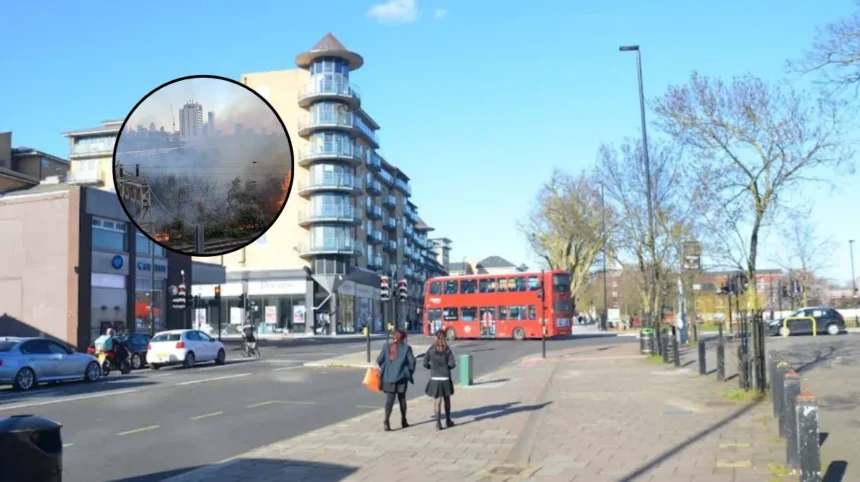
Key Points:
- A trackside fire occurred in Feltham, west London, causing major disruption to rail services.
- The incident forced the closure of lines on Saturday morning, bringing South Western Railway (SWR) trains operating in and out of London Waterloo station to a standstill.
- Live arrivals and departures boards at London Waterloo showed delays and cancellations affecting dozens of train services.
- Emergency services and rail network engineers responded to the site to manage the blaze and inspect line infrastructure.
Waterloo (West London News) August 15, 2026 – A trackside fire in Feltham, west London, has caused major operational disruption across the South Western Railway network, bringing passenger services in and out of London Waterloo station to a standstill on Saturday morning. The blaze broke out adjacent to the running lines in the Feltham area, forcing emergency services and Network Rail engineers to enforce an immediate line closure on safety grounds. As a consequence of the closure, live departure and arrival screens at London Waterloo displayed widespread delays, short-notice alterations, and cancellations, leaving thousands of weekend travellers stranded or facing extended journey times across key commuter corridors in the south and south-west of England.
- Key Points:
- What Caused the Major Disruption to South Western Railway Trains at London Waterloo?
- How Widespread Is the Impact on Passengers Travelling Through West London?
- What Steps Are Being Taken to Clear the Line and Restore Services?
- Background of the Feltham Trackside Fire and Network Infrastructure Vulnerabilities
- Prediction: How Will This Disruption Affect Commuters and Weekend Travellers?
What Caused the Major Disruption to South Western Railway Trains at London Waterloo?
The operational paralysis affecting London Waterloo stems directly from a trackside fire reported during the early hours of Saturday morning near Feltham in west London. Fire crews were dispatched to the location to contain the flames, while railway safety controllers took the precautionary measure of isolating electrical power to the lines in the immediate vicinity. Because Feltham serves as a key arterial node on the South Western Railway network, the necessity to halt train movements through the affected section immediately created a severe bottleneck.
Trains heading eastbound towards London Waterloo and westbound towards major suburban hubs were brought to a stop or held at intermediate stations while firefighters worked alongside track maintenance teams to ensure the area was safe.
How Widespread Is the Impact on Passengers Travelling Through West London?
The closure of the lines near Feltham triggered a cascade of delays across the entire South Western Railway route network. Live journey monitoring tools at London Waterloo station showed dozens of services listed as delayed or cancelled as the morning progressed. Passengers arriving at the concourse were met with congested platforms and rapidly updated departure boards reflecting the ongoing network instability.
Network Rail and South Western Railway personnel implemented emergency line management procedures, attempting to divert select services where route availability permitted. However, due to the high density of train movements typically scheduled through west London on a Saturday morning, the loss of throughput capacity at Feltham caused widespread queueing of rolling stock across adjacent rail sectors.
What Steps Are Being Taken to Clear the Line and Restore Services?
Emergency service crews prioritized suppressing the trackside fire to allow railway engineering teams safe access to the track bed and surrounding signaling infrastructure. Trackside fires routinely present risks to critical line equipment, including signal cabling, line-side relay boxes, and third-rail electrical systems. Safety inspectors must conduct thorough physical checks to verify that heat from the blaze has not compromised structural components or line safety sensors before authorization can be granted to reopen the tracks to commercial passenger traffic.
South Western Railway customer service teams advise passengers to check digital travel updates before departing for their stations and to consider alternative transport routes where available, as operational recovery following a line closure usually requires several hours to fully re-align delayed rolling stock and train crews.
Background of the Feltham Trackside Fire and Network Infrastructure Vulnerabilities
Trackside fires along busy UK urban rail corridors represent a recurring operational hazard for railway infrastructure managers, particularly in heavily built-up sectors of west London. The rail corridor passing through Feltham forms part of the historical Windsor lines network, carrying heavy daily passenger volumes between London Waterloo, Reading, Windsor & Eton Riverside, and various intermediate Thames Valley towns.
Because railways rely heavily on trackside cabling for signaling power, communications, and automatic train protection systems, any fire developing on the railway embankment or within line-side vegetation can quickly compromise essential control hardware. Historical data from railway operations indicates that line-side blazes frequently originate from secondary sources, such as dry vegetation igniting during warm weather, electrical arcing on conductor rails, or external rubbish accumulation adjacent to boundary fencing. When a line closure is mandated, the ripple effect on London Waterloo—Britain’s busiest railway terminal by passenger volume—is almost immediate, as incoming trains are unable to clear platform spaces, preventing outward-bound services from departing on schedule.
Explore More Feltham News
18-Year-Old Stabbed Dead in Feltham; Three Teens Arrested
UWL Launches Free Feltham Courses with Hounslow Council Partnership
Prediction: How Will This Disruption Affect Commuters and Weekend Travellers?
The immediate impact of the Feltham fire will be felt primarily by weekend leisure travellers, local commuters, and sports fans relying on South Western Railway lines to access central London and adjacent venues. In the short term, passengers can expect severe overcrowding on alternative routes, extended journey times, and irregular service frequencies as South Western Railway works to position displaced trains and staff back into their correct operational diagrams.
Over the longer term, this incident is likely to renew focus on Network Rail’s ongoing line-side vegetation management and infrastructure risk mitigations along high-density London corridors. For regional businesses, transport-dependent retail venues in central London, and regional hospitality sectors, line disruptions of this magnitude result in diminished weekend footfall and financial losses. Rail consumer advocacy groups are expected to monitor the recovery response closely, pressing passenger transport operators for clear delay-repay compensation processing and improved real-time communication during emergency events.