Key Points
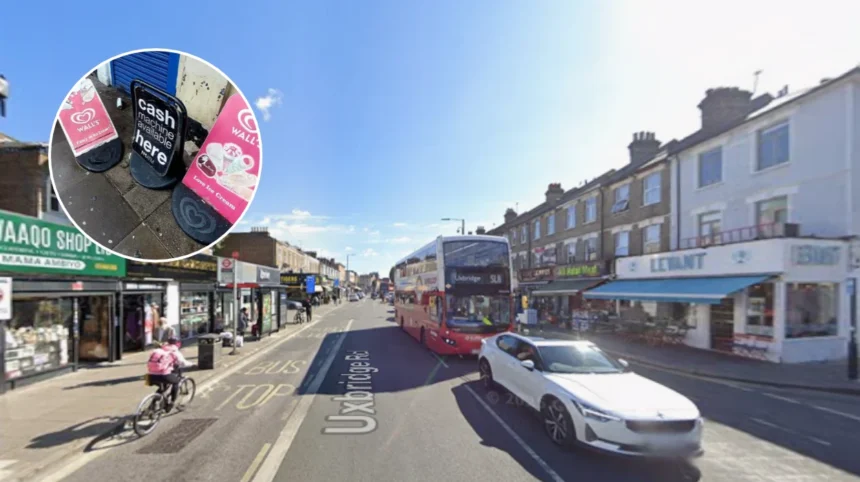
- Hammersmith & Fulham Council is to introduce a 12-month trial ban on A-board advertisements along the Uxbridge Road in Shepherd’s Bush, coming into effect in October.
- The 12-month trial will act as a period of consultation towards a scheme aimed at banning A-boards in the whole borough from being placed on highways.
- Campaign group Fix Uxbridge Road fully backs the proposal to ban the A-boards due to their impact on accessibility.
- According to council documents, despite the existence of a license for placing an A-board on highways for £275 per year, the license applications are few and penalties have been very limited.
- Accessibility campaigners, such as the Disabled Residents Team, warned about the risk of injury to blind, partially sighted and mobility impaired pedestrians.
Shepherd’s Bush (West London) — September 7, 2026 — Hammersmith and Fulham Council is set to temporarily ban advertising boards on a key West London road as part of a wider consultation on a potential borough-wide scheme. The local authority stated that it received a high volume of concerns from residents regarding advertisements, commonly known as A-boards, particularly regarding their intensive deployment along Uxbridge Road. The restriction targeting boards along the Shepherd’s Bush highway will remain active for 12 months starting from October, functioning as a trial to dictate whether a full roll-out across the entire borough should take place.
A-boards are widely utilised on high streets throughout the country to promote various commercial services and products. However, their deployment has faced substantial criticism in multiple districts due to narrowing walking spaces and creating unnecessary visual clutter. Neighbouring authorities such as Westminster and Kensington and Chelsea are among the capital’s local bodies that already do not authorise A-boards on the public highway. Currently, fulham/hammersmith/">hammersmith-and-fulham/">Hammersmith and Fulham Council charges an annual fee of £275 to issue a highways licence permitting an A-board, though a 2025 survey estimated there could be up to 950 unlicensed boards across the borough.
How Are Local Businesses and Campaign Groups Reacting to the Proposed Measures?
As detailed in council reports covered by Ben Lynch of MyLondon, local authorities traditionally managed unauthorised A-boards by informally requesting businesses to remove them, reflecting a desire to support small traders and avoid formal penalties. Council officers noted in official documents:
“In practice, however, licences are generally not applied for, and the absence of a licence has rarely been enforced through the issue of a fine. The council has usually sought to deal with unauthorised A-boards by asking businesses to remove them. This approach has reflected a desire to support small businesses, avoid formal enforcement action and resolve issues informally wherever possible.”
Vikki, speaking as a representative for the campaign group Fix Uxbridge Road, offered strong backing for the local authority’s decision. As documented by MyLondon, Vikki stated that:
“Successful high streets depend on people being able to reach shops, move between them and enjoy spending time there. Businesses can advertise through shopfronts, windows, awnings, digital channels and coordinated street signage without placing obstacles in pedestrian routes.”
She added:
“A thriving high street is one that everyone can use. Clear the boards. Clear the way. Make our high streets accessible to everyone.”
Furthermore, Fix Uxbridge Road emphasised that the measure should act as a baseline, asserting that invisible property boundaries on publicly accessible forecourts should not exempt obstacles from safety rules.
Explore more Hammersmith and Fulham News:
Dr Nirja Joshi Launches Empower Her Dance Initiative in Fulham 2026
Hammersmith Ram Pub Reopens as Discount Store Unlawfully: Hammersmith 2026
What Are the Primary Safety and Accessibility Concerns Raised by Stakeholders?
According to findings outlined by MyLondon journalist Ben Lynch, Uxbridge Road accumulated a disproportionate share of complaints relating to street obstructions. Consultations with the council’s Disabled Residents Team confirmed broad support for immediate restrictions. A formal survey evaluating commercial impact received five responses, split on direct commercial outcomes, though three respondents agreed the local authority should prohibit highway placement entirely.
Council officers explicitly summarised the core dangers within their report, writing:
“A-boards can provide a useful and low-cost form of advertising for businesses, but their uncontrolled use on the public highway creates street clutter, can obstruct pedestrians and raises particular accessibility concerns for blind and partially sighted people.”
The report further detailed:
“For blind and partially sighted people, wheelchair and mobility-aid users, older residents, and parents and carers with pushchairs, A-boards are unpredictable obstacles that narrow walking routes, force people away from the building line, create collision and trip risks, and can push pedestrians dangerously close to traffic.”
Background of the Particular Development
The push to regulate and remove pavement advertising boards stems from longstanding advocacy by accessibility groups and urban planners across Greater London. Local councils face mounting tension between supporting independent brick-and-mortar retail outlets struggling with digital competition and ensuring public thoroughfares comply with statutory accessibility obligations.
Past initiatives by other London authorities, such as the City of London Corporation’s 2019 pavement clearance strategy, established precedents demonstrating that removing physical clutter significantly improves urban navigation for disabled citizens. Hammersmith and Fulham’s latest move formalises years of informal complaints, transitioning from passive advisory measures to active regulatory enforcement via a structured, monitored trial period.
This 12-month trial on Uxbridge Road is expected to serve as a pivotal testing ground that could heavily influence commercial high-street policies across outer London boroughs. For local retailers and small business owners operating within Hammersmith and Fulham, the potential permanent removal of A-boards means shifting advertising expenditures toward digital channels, window displays, or council-approved signage, potentially raising operational overheads.
Conversely, for pedestrians, wheelchair users, and visually impaired residents, the elimination of these physical barriers promises a safer, more predictable, and accessible pedestrian environment, likely setting a benchmark for future municipal street-management frameworks throughout the capital.