Key Points
- Around 150 anti-racist counter-demonstrators heavily outnumbered a gathering of roughly 20 Ukip supporters in Hyde Park.
- Ukip leader Nick Tenconi organized the march under the slogan “No to sharia law”.
- The counter-protest was organized by West London Stand Up to Racism (SUTR) alongside local trade unions, civil society groups, and community members.
- Participating organizations included the Brent Trades Council, Ealing NEU union branch, Hammersmith and Fulham Unison, local Green Party councillors, and representatives from the Sudanese community and Palestine activists.
- Campaigners highlighted the importance of grassroots solidarity to oppose right-wing rhetoric targeting migrants and religious minorities.
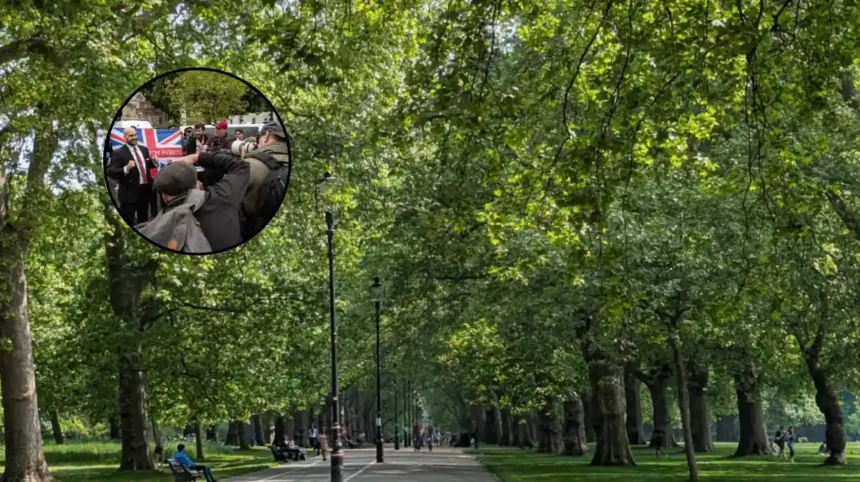
Hyde Park (West London News) August 29, 2026 – Anti-racist counter-demonstrators heavily outnumbered supporters of the UK Independence Party (Ukip) during a march through Hyde Park on Saturday, despite significant police presence separating the two groups.
Ukip leader Nick Tenconi had convened the march under the banner of “No to sharia law”, attracting a small delegation of approximately 20 supporters. However, as the group proceeded through the park, they were confronted by a mobilized counter-demonstration of around 150 anti-racists called by West London Stand Up to Racism (SUTR).
The mobilization drew broad backing from across the local community, uniting trade union members, educators, municipal workers, political representatives, and local activist groups in a organized show of opposition.
What Occurred During the Demonstrations at Hyde Park?
The march organized by Nick Tenconi was met with immediate and overwhelming opposition upon entering Hyde Park. The counter-demonstration organized by SUTR mobilized community representatives, including members of the Brent Trades Council, the Ealing branch of the National Education Union (NEU), and the fulham/hammersmith/">hammersmith-and-fulham/">Hammersmith and Fulham Unison branch. Strike supporters from the Institute of Cancer Research (ICR) and members of the Sudanese community and local Palestine activist groups also joined the blockade.
Organizers characterized the response as a collective community effort aimed at challenging right-wing marches within public spaces. Miça, an activist with SUTR and Women Against the Far Right in west London, observed that
“It was truly a collective effort… It shows we’ve got community on our side, we’ve got everyday, working people on our side.”
Miça added that the presence of educators from the NEU union, council workers from Unite and Unison, members of the Ealing Community Independents, and local Green Party councillors demonstrated a broad alliance against right-wing organizing.
Why Are Educators and Unions Challenging Right-Wing Rhetoric?
Trade union representatives present at the counter-demonstration emphasized the impact of political rhetoric on local public services and community cohesion. Educators highlighted concerns over how public discourse affects children and students from minority backgrounds within the education system.
Matt, an educator and member of the Ealing NEU, expressed the widespread sentiment among teaching professionals regarding social media messaging and political campaigning:
“I think I can speak on behalf of pretty much every NEU member when I say that the far right and their rhetoric is a real danger to education and to the wellbeing of children.”
He added,
“We see this in their rhetoric on social media. It’s always migrants and Muslims they blame, many of whom are our students.”
Background of the Particular Development
Public demonstrations involving far-right organizations, anti-racist coalitions, and trade union bodies have seen increased activity across the United Kingdom in recent years. Smaller political factions like Ukip have regularly attempted to organize public rallies focused on themes surrounding culture, immigration, and religious practices. In response, groups such as Stand Up to Racism (SUTR), alongside local trade union councils, have systematically coordinated counter-mobilizations to limit the visibility and reach of these events. The involvement of major public sector unions—including the NEU, Unison, and Unite—reflects an established strategy within the British labor movement to actively confront political groups whose platforms they view as hostile to multicultural public institutions and worker solidarity.
Predictions for How This Development Can Affect Local Communities and Trade Unions
The high ratio of counter-demonstrators relative to Ukip attendees is likely to reinforce local community coalition strategies in West London and similar urban centers. For local residents, educators, and public sector workers, the turnout demonstrates the perceived effectiveness of joint action between trade unions and grassroots activists in preventing far-right groups from establishing a dominant presence in public spaces. In the coming months, trade unions such as the NEU and Unison are expected to maintain active anti-racism campaigns within schools and municipal workplaces to address tensions driven by online political commentary. Furthermore, small political groups like Ukip may reconsider the format and public promotion of future rallies when faced with organized, multi-organizational opposition.