Key Points
- A massive new artwork titled I’m Mr. Mercury has been unveiled on the Spanish Steps in Wembley Park.
- The street art celebrates the late Queen frontman Freddie Mercury ahead of what would have been his 80th birthday.
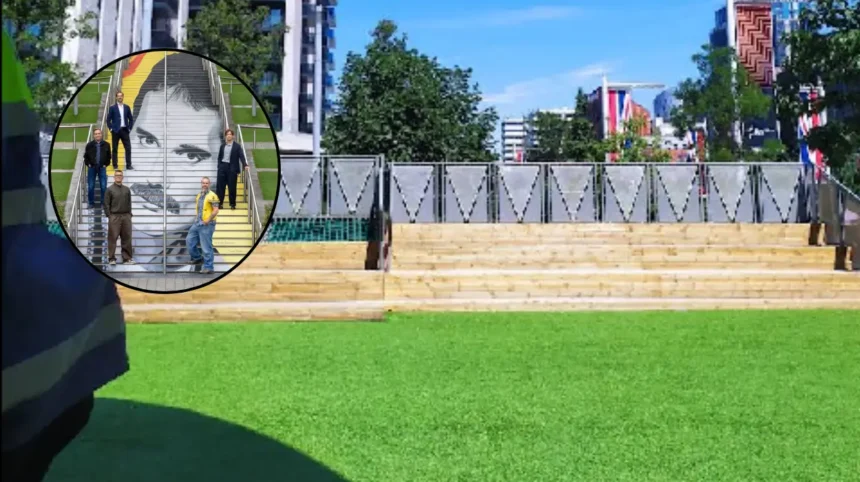
- Created by British street artist Frank Styles, the piece spans across all 58 steps linking Wembley Stadium and OVO Arena Wembley.
- The artwork uses an anamorphosis perspective effect, aligning into a cohesive, giant image of Mercury only when viewed from a marked observation point opposite the steps.
brent/wembley/">Wembley (West London News) September 3, 2026 – A striking new public landmark commemorating the iconic Queen frontman Freddie Mercury has been officially unveiled at Wembley Park, marking an early tribute ahead of what would have been the singer’s 80th birthday. Titled I’m Mr. Mercury, the expansive street art installation spans all 58 steps of the iconic Spanish Steps, which connect two of London’s most historic entertainment venues: Wembley Stadium and OVO Arena Wembley.
The tribute was designed and executed by British street artist Frank Styles. Using anamorphic perspective techniques, Styles painted individual sections across the risers of each step. When viewed from standard angles on the staircase, the artwork appears as abstract geometric bands of colour. However, when observers stand at a specially designated viewing point positioned directly opposite the steps, the perspective aligns to reveal a unified, larger-than-life portrait of Mercury in his classic performance pose.
The location of the installation holds deep symbolic resonance for fans of Queen and rock music history. Wembley was the setting for several of Mercury’s most legendary live performances, most notably Queen’s seminal 20-minute set during the Live Aid concert on 13 July 1985, as well as their two sold-out performances on the Magic Tour in July 1986.
By placing the mural directly on the pedestrian thoroughfare between the stadium and the arena, developers and organizers have integrated a piece of British music history directly into the modern landscape of the Wembley Park cultural quarter. The installation serves as both an optical attraction for visitors and a permanent nod to the singer’s enduring artistic legacy in the capital.
What is the Significance of the Spanish Steps in Music History?
The Spanish Steps in Wembley Park serve as a primary physical bridge between Wembley Stadium and OVO Arena Wembley (formerly known as the Empire Pool). Millions of music fans have traversed this specific walkway over the decades while attending major concerts, sporting events, and cultural festivals.
Placing a tribute to Freddie Mercury on this specific structure connects the modern physical space directly to the landmark events that defined his career in the 1980s.
Organizers selected the venue to ensure the artwork sat within the immediate footprint of the grounds where Mercury delivered some of the most celebrated live vocals in rock history.
How Did Artist Frank Styles Create the Anamorphic Installation?
Creating artwork on an optical surface as fragmented as a 58-step outdoor staircase requires specialized mathematical alignment and painting methods.
Anamorphosis is an optical illusion technique where an image is distorted in such a way that it can only be reconstructed into a coherent visual form when viewed from a precise, predetermined location or through a specific reflective device.
To complete I’m Mr. Mercury, artist Frank Styles mapped out the source image across 58 separate vertical surfaces. Each step riser acts as a horizontal slice of the overall picture. Styles worked across the steep gradient to ensure that from normal walking perspectives, the steps remain clear for everyday pedestrian access, while from the marked sightline across the plaza, the image resolves into the complete portrait of Mercury.
Explore More Wembley News
Three Charged Over Fatal Stabbing of David Wynter in Wembley 2026
Wembley Stabbing: Two More People Charged With Murder Of 17- Year- Old
Background of Freddie Mercury’s Connection to Wembley
Freddie Mercury, born Farrokh Bulsara on 5 September 1946, moved to Feltham, West London, in his late teens. His ascent with Queen during the 1970s and 1980s established him as one of the most distinctive vocalists and showmen in global popular music.
Mercury’s history with the Wembley complex spans multiple decades and high-profile performances:
- Live Aid (13 July 1985): Queen took the stage at Wembley Stadium alongside dozens of international acts. Their brief, highly energetic performance—featuring songs like Bohemian Rhapsody, Radio Ga Ga, and We Will Rock You—is widely cited by critics and industry polls as one of the greatest live rock performances of all time.
- The Magic Tour (11–12 July 1986): Queen played two consecutive sold-out nights at Wembley Stadium to over 150,000 fans. Mercury performed wearing his famous yellow military-style jacket, an image that remains one of the most recognized visual associations with his career.
- The Freddie Mercury Tribute Concert (20 April 1992): Following Mercury’s death in November 1991 from AIDS-related complications, the surviving members of Queen organized an all-star tribute concert at Wembley Stadium to celebrate his life and raise awareness for AIDS research, drawing a stadium crowd of 72,000 and a global broadcast audience.
The installation of I’m Mr. Mercury on the Spanish Steps reinforces the physical link between the physical location and Mercury’s historical contributions to British live performance culture.
What is the Impact of This Cultural Development on Visitors and the Local Area?
The unveiling of I’m Mr. Mercury on the Spanish Steps will influence local tourism, visitor movement, and the surrounding Wembley Park neighborhood across several areas:
The mural introduces a distinct physical gathering point for international and local Queen fans visiting North London. Because the full visual effect relies on standing at a specific, designated spot, the installation creates a predictable foot-traffic zone for photography and public gatherings ahead of major events at the stadium and arena.
As part of the ongoing urban development around Wembley Stadium, public art installations like Frank Styles’s mural are designed to draw steady foot traffic outside of event days. Local businesses, retail stores, and dining establishments in the Wembley Park district are likely to see increased visitor dwell time as tourists travel to view the street art.
The artwork serves as an educational and cultural touchstone for younger audiences visiting the district. By integrating historical tributes directly into functional public infrastructure like staircases, the area retains its historic connection to 20th-century music heritage while operating as a modern residential and entertainment complex.