Key Points
- Richmond Council has renewed calls for Hammersmith Bridge to reopen to public transport and emergency services, and says it does not accept a pedestrian-and-cyclist-only future as “the end of the story”.
- A council report says plans for a full vehicle reopening have been shelved because there is “no financial option available” for complete restoration.
- The bridge has been closed to motor traffic since 2019, while pedestrians and cyclists can still use it.
- The Department for Transport has advised a phased repair approach rather than full restoration for motor traffic.
- Richmond and Hammersmith and Fulham councils continue to disagree over the long-term funding and restoration strategy.
Richmond (West London News) July 16, 2026, and the Department for Transport are at the centre of a renewed row over the future of fulham/hammersmith/">Hammersmith Bridge after the latest vehicle reopening plans were shelved. As reported by the London title covering the story, Richmond Council said it refused to accept the latest position as the final word on the bridge’s future.
Richmond Council has argued that the bridge should ultimately serve more than pedestrians and cyclists, with the local authority continuing to press for a “fully connected” crossing.
The council’s stance comes after the latest assessment concluded that fully restoring the bridge for vehicles would not be financially workable under current plans.
Why were car plans shelved?
The key reason given in the council report is cost. The report says there is no financial option available that would allow for a full restoration of the Grade II listed bridge to safely carry cars again.
BBC reporting on the same development said the repairs needed would effectively require building an entirely new bridge, underlining how extensive the work would be.
According to the reporting, the Department for Transport has pushed for a phased repair model instead of a full rebuild-style restoration.
That approach would prioritise keeping the bridge safe for the uses it still supports rather than reopening it fully to motor vehicles.
What is the bridge used for now?
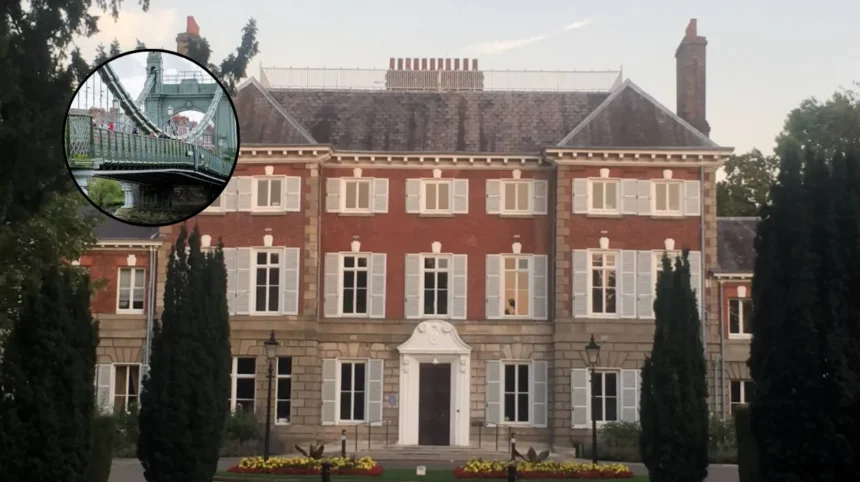
Hammersmith Bridge remains closed to motor traffic, but it is open to pedestrians and cyclists. Government material says cyclists and pedestrians can continue to use the bridge safely while strengthening work is carried out, and that the bridge was reopened to these users in 2021 after the earlier closure.
A later update from local reporting said a £2.9 million resurfacing project created separated pedestrian and cycle lanes, allowing cyclists to cross without dismounting.
That means the bridge continues to function as a walking and cycling route while longer-term structural decisions remain unresolved.
How much has been spent?
Spending on the bridge has already been substantial. Local reporting said more than £50 million had been spent since the partial closure, including stabilisation and pre-restoration work. The same report said the council’s spending had reached £54 million by last October.
The financial dispute matters because different bodies do not agree on who should pay for what. According to the report, the council says it is owed money from the Department for Transport and Transport for London, while the Department for Transport says repair and maintenance remain the council’s responsibility.
What do the authorities disagree on?
The disagreement is not only about engineering but also about ownership, funding, and responsibility. Hammersmith and Fulham Council has previously said the split in costs is unprecedented, while central government has maintained that it has already contributed to keeping the bridge open for walking and cycling.
That dispute helps explain why long-term decisions have moved slowly. Earlier reporting also noted that more ambitious restoration proposals had been delayed in the past, with political and funding issues repeatedly affecting progress.
What does the reporting say about timing?
The current report does not give a date for any return of motor traffic, and the emphasis is on the shelving of the vehicle plan rather than a reopening timetable.
The broader reporting suggests that a full return to cars has moved further out of reach, while the bridge’s present pedestrian-and-cycle use is likely to continue in the meantime.
The latest funding and engineering context also indicates that any future work is constrained by deadlines and by the scale of the repairs required. In practical terms, that leaves the bridge in a long-running holding pattern rather than near a full reopening.
Background of the development
Hammersmith Bridge was closed to motor traffic in 2019 after cracks were discovered in its pedestals, and it has remained a major London infrastructure issue ever since.
Since then, different repair, strengthening and reopening proposals have been discussed, but the bridge’s historic status and the scale of the damage have made a full fix difficult.
The bridge has already gone through temporary changes to keep it usable for walking and cycling, including resurfacing and segregated lanes.
At the same time, central government, local councils and Transport for London have continued to debate who should pay and what level of restoration is realistically achievable.
Explore More Richmond News
Richmond £1.5m Town Centre Plans Approved? Public Square, Play Area Revealed Richmond 2026
Richmond Snow Ice Storm: Emergency Declared, Outages Expected
Prediction for residents and commuters
For residents in Richmond, Barnes, Hammersmith and nearby areas, the most likely short-term outcome is continued access for pedestrians and cyclists, but not for private cars or full public transport.
If the phased repair approach moves ahead, the bridge may remain in use, but its role as a major road crossing is unlikely to return soon.
For commuters and emergency planning, that means the bridge will probably stay a local walking and cycling asset rather than a full traffic artery.
For people hoping for a fast vehicle reopening, the latest reporting suggests the opposite direction: fewer expectations of a full return, and more focus on managing the bridge in its current limited form.