Key Points
- Historic Astronomical Event: London and the wider United Kingdom experienced their deepest solar eclipse since 1999 on Wednesday evening, 12 August 2026, with the Moon obscuring up to 91.4 per cent of the solar disc over the capital.
- Exact Timings: The event spanned nearly two hours, beginning at 18:17 BST, reaching peak coverage at 19:13 BST, and concluding at 20:06 BST as the Sun approached the western horizon.
- Widespread Coverage: While London saw over 91 per cent coverage, other parts of Britain witnessed even greater obscuration, reaching up to 96 per cent in southwestern Cornwall.
- Viewing Conditions & Safety: Public health officials and astronomers issued strict safety warnings requiring certified solar filters, as looking directly at the partial eclipse without protection risks permanent retinal damage.
- Subsequent Sky Events: The eclipse coincided with the peak of the annual Perseid meteor shower on the night of 12 August 2026, benefiting from dark, moonless skies following the new moon phase.
- Future Eclipse Timeline: The United Kingdom will not experience another comparably deep partial solar eclipse until 2050 and 2081, while the next total solar eclipse visible from the British mainland will not occur until 23 September 2090.
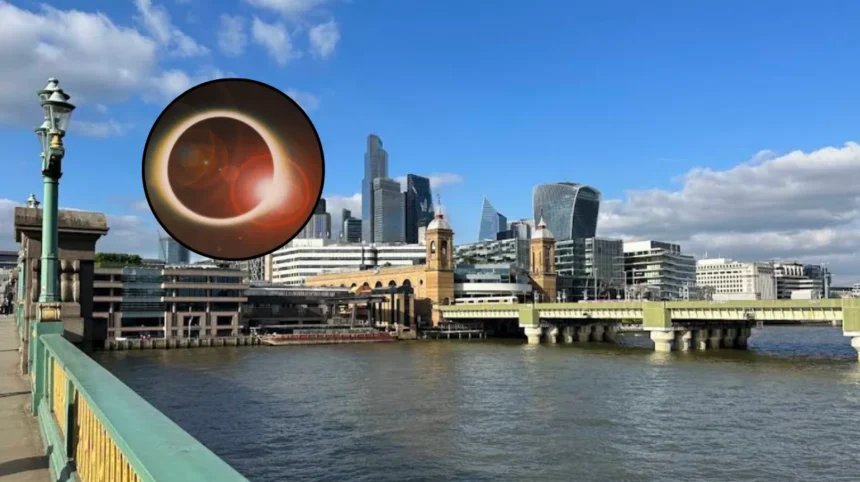
London (West London News) August 13, 2026 – Londoners gathered across rooftop terraces, Royal Parks, and elevated Thames bridges on Wednesday evening to witness a spectacular partial solar eclipse, marking the deepest obscuration of the Sun observed over the capital since 1999. The celestial spectacle began at 18:17 BST as the Moon made first contact with the solar disc, steadily tracking across the Sun over a period of nearly two hours. Maximum coverage was achieved at 19:13 BST, when approximately 91.4 per cent of the Sun was hidden behind the Moon, leaving only a thin, downward-pointing crescent of sunlight visible in the western sky before the event concluded at 20:06 BST.
- Key Points
- What Happened During London’s Deepest Solar Eclipse Since 1999?
- What Were The Exact Timings And Viewing Conditions Across London?
- What Safety Precautions And Viewing Methods Were Recommended By Experts?
- What Atmospheric Phenomena And Sky Events Accompanied The Eclipse?
- What Is The Background To This Particular Astronomical Development?
- Prediction: How Will Future Solar Developments Affect Londoners And Skygazers?
What Happened During London’s Deepest Solar Eclipse Since 1999?
The celestial mechanics of Wednesday’s eclipse brought a rare visual spectacle to millions of observers across the capital and the wider country. As reported by Hannah Devlin of The Guardian, Dr Carys Herbert, an astronomer at the Royal Observatory Greenwich, stated that
“people in Cornwall would experience about 96% coverage, while people in the west of Scotland would experience 93% coverage and people in London would see about 92% coverage.”
Although the line of total eclipse crossed eastern Greenland, western Iceland, and northern Spain, the British Isles sat directly adjacent to the path of totality. As reported by Jamie Carter of BBC Sky at Night Magazine, major UK cities experienced a very deep partial eclipse, with all observers across Britain seeing the Moon track across the Sun from right to left. Carter noted that this movement created
“a frown-shaped crescent – with the horns pointing downward – at the moment of maximum eclipse.”
Astronomers at Royal Museums Greenwich confirmed that while the UK experienced a partial event rather than totality, the proportion of the Sun covered surpassed any solar eclipse visible from the British mainland since 11 August 1999, when the path of totality crossed Cornwall and South Devon.
What Were The Exact Timings And Viewing Conditions Across London?
In London, the celestial event unfolded low in the evening sky as the Sun dipped towards the west-northwestern horizon.
First contact occurred precisely at 18:17 BST, when the lunar silhouette first began to bite into the edge of the solar perimeter. Over the subsequent 56 minutes, the shadow expanded steadily across the face of the Sun.
By 19:13 BST, the eclipse reached its peak magnitude. At this juncture, the Sun sat approximately 10 to 15 degrees above the horizon, delivering a distinct twilight atmosphere across London’s landmark locations, including Primrose Hill, Greenwich Park, and Parliament Hill.
The event drew to a close at 20:06 BST as the Moon completed its crossing, leaving the Sun just 1 to 2 degrees above the horizon barely twenty minutes before sunset.
As reported by Jamie Carter of BBC Sky at Night Magazine, the low elevation of the Sun meant that observers required an entirely unobstructed view toward the west-northwest.
Observers positioned in open parks or elevated terrain reported clearer views than those in narrow street corridors where buildings obscured the horizon.
What Safety Precautions And Viewing Methods Were Recommended By Experts?
Throughout the build-up to the event, health authorities and astronomical organisations stressed the imperative need for certified protective eyewear.
As reported by the UK Health Security Agency (UKHSA), viewing a partial solar eclipse presents specific optical hazards because the dimmed overall brightness can override the human eye’s natural blink reflex, allowing damaging infrared and ultraviolet radiation to strike the retina without causing immediate pain.
Following the historical precedents of earlier solar events, medical authorities reminded the public that standard sunglasses—regardless of how dark their tint—provide insufficient filtering power against solar radiation.
Astronomers from the Society for Popular Astronomy and Royal Museums Greenwich advised the public to use certified ISO 12312-2 solar viewer glasses, dedicated pinhole projection boxes, or specialized aperture filters fitted to optical equipment such as telescopes and binoculars.
To accommodate those unable to secure proper viewing apparatus or whose views were obstructed by localized cloud cover, the Royal Observatory Greenwich broadcasted a live online stream on YouTube and Facebook from 18:10 BST to 20:00 BST, utilizing optical solar telescopes mounted at the Greenwich site.
What Atmospheric Phenomena And Sky Events Accompanied The Eclipse?
Beyond the gradual dimming of daylight, the timing of Wednesday’s eclipse created a unique dual astronomical phenomenon. Because a solar eclipse occurs exclusively during a new moon, the night sky immediately following the event was left completely devoid of moonlight.
As reported by Jamie Carter of BBC Sky at Night Magazine, this alignment coincided directly with the annual peak of the Perseid meteor shower on the night of 12 August 2026.
The absence of lunar glare provided optimal dark-sky conditions for observing meteor trails across Britain later into the night.
Furthermore, as reported by Hannah Devlin of The Guardian, Dr Carys Herbert of the Royal Observatory Greenwich explained that because solar eclipses require the Sun, Moon, and Earth to line up along the same orbital plane, lunar eclipses naturally occur roughly two weeks before or after a solar eclipse.
Dr Herbert noted that skygazers in the UK will be able to observe a partial lunar eclipse in the early morning hours of 28 August 2026, commencing just after 05:00 BST.
Explore More UK News
Met Office Considers 36C Heat Warning, UK 2026
Man Charged After Fatal Huyton Crash Kills Four: Huyton 2026
What Is The Background To This Particular Astronomical Development?
A solar eclipse occurs when the Moon passes directly between the Earth and the Sun, casting its shadow across portions of the Earth’s surface. Because the Moon’s orbit around the Earth is tilted by approximately five degrees relative to the Earth’s orbital plane around the Sun, the three celestial bodies do not align every month.
Such alignments occur only when a new moon coincides with one of the two orbital nodes where the lunar path crosses the ecliptic plane.
Solar eclipses take four primary forms: total, partial, annular, and hybrid. During a total solar eclipse, the Moon’s inner shadow cone (the umbra) touches the Earth’s surface, completely blocking the solar disc and revealing the Sun’s outer atmosphere, known as the corona.
In a partial solar eclipse, such as the event visible from London on 12 August 2026, observers stand within the outer penumbral shadow, where only a fraction of the Sun is obscured.
Statistically, while two to five solar eclipses take place globally each year, total solar eclipses recur over any specific location on Earth only once every 375 to 400 years on average. The British Isles have a long recorded history of solar eclipse observations.
The last total solar eclipse visible from UK soil occurred on 11 August 1999, when the umbral path encompassed Cornwall and South Devon. Prior to 1999, the UK last witnessed totality on 29 June 1927 across northern England and Wales.
Recent notable partial eclipses visible from London include the deep partial eclipse of 20 March 2015—which reached approximately 84 per cent obscuration in the capital—and minor partial events on 10 June 2021 and 29 March 2025.
However, Wednesday’s 91.4 per cent coverage represents the most substantial solar coverage observed over London in twenty-seven years.
Prediction: How Will Future Solar Developments Affect Londoners And Skygazers?
The passage of Wednesday’s eclipse marks the beginning of a prolonged hiatus for major solar events over London and the United Kingdom.
Skygazers residing in the capital will face an extended wait before witnessing another partial eclipse of comparable depth, while a total solar eclipse over London remains a once-in-a-lifetime prospective event.
According to astronomical calculations published by Royal Museums Greenwich and NASA’s Eclipse Web Site, the United Kingdom will experience several minor partial solar eclipses over the coming decade, but none will match the 90-plus per cent coverage seen on 12 August 2026.
The next partial eclipse visible from Britain will occur on 2 August 2027, though coverage in London will be substantially lower, reaching roughly 30 to 40 per cent.
For Londoners seeking to experience a deep partial eclipse exceeding 80 per cent obscuration, predictions indicate that the next comparable event over the UK will not occur until 1 July 2050, followed by another significant partial event on 3 September 2081.
For those anticipating a total solar eclipse on British soil, astronomical models confirm that totality will next visit the United Kingdom on 23 September 2090. On that date, the path of totality will sweep across southwestern England, including Cornwall and Devon, in a p
attern reminiscent of the 1999 event. However, from the vantage point of London, the 2090 eclipse will remain a very deep partial event rather than complete totality.
Consequently, London residents wishing to experience the full effect of a total solar eclipse within the near future will need to travel internationally to locations situated within upcoming umbral paths, such as the total solar eclipses scheduled across Australia and New Zealand in July 2028, or North Africa and the Middle East in August 2027.