Accessibility in West London covers transport, streets, buildings, attractions, toilets, parking, digital services and assistance for people with disabilities or reduced mobility. The area has extensive step-free transport, accessible buses, adapted attractions and council support, but facilities differ by location and venue.
- What does accessibility mean in West London?
- How accessible is public transport in West London?
- Which West London transport options are best for wheelchair users?
- How can you plan an accessible journey across West London?
- Which West London attractions have strong accessibility facilities?
- How accessible are parks and outdoor spaces in West London?
- What accessibility support is available for sensory disabilities?
- What accessible parking and Blue Badge services are available in West London?
- What financial and travel support is available for disabled people in West London?
- How accessible are West London’s council and digital services?
- How does the Equality Act protect accessibility in West London?
- How are West London boroughs improving accessibility?
- What should visitors check before an accessible trip to West London?
- What does the future of accessibility in West London look like?
West London is a large and diverse part of the capital. It includes places such as Ealing, Hounslow, fulham/hammersmith/">hammersmith-and-fulham/">Hammersmith and Fulham, Richmond upon Thames, Brent, Chiswick, Acton, Kew, Twickenham, Hammersmith, Wembley and Heathrow.
Accessibility in the area depends on several connected systems. Transport for London (TfL) manages much of the public transport network. London boroughs manage local streets, parking, social care and community services. Individual attractions, theatres, museums, hotels and businesses manage their own visitor facilities.
The legal framework also matters. The Equality Act 2010 protects disabled people from discrimination and establishes duties concerning reasonable adjustments. Public authorities have an anticipatory duty to consider accessibility needs rather than waiting for an individual problem to occur.
For visitors, accessibility means more than wheelchair access. It includes step-free entrances, accessible toilets, hearing support, visual information, quiet environments, assistance dogs, accessible parking, sensory services and clear digital information.
What does accessibility mean in West London?
Accessibility in West London means removing physical, sensory, communication and transport barriers so disabled people can use public services, travel networks, attractions and everyday facilities with greater independence. Accessibility includes ramps, lifts, accessible toilets, low-floor buses, visual information, hearing loops, assistance and alternative formats.
The concept covers several forms of access. Physical accessibility concerns entrances, paths, doors, lifts and toilets. Transport accessibility concerns buses, trains, Underground stations, taxis and river services. Sensory accessibility concerns hearing, sight, lighting, noise and information.
Communication accessibility includes British Sign Language (BSL), captions, audio description, large-print information and easy-read material. Digital accessibility covers websites, mobile applications and online booking systems.
West London’s accessibility therefore cannot be measured by wheelchair access alone. A venue with a ramp but no accessible toilet has an incomplete access offer. A station with step-free platforms but a broken lift also creates a practical barrier.
The Equality Act 2010 is the central UK legal framework for disability discrimination. Government guidance states that reasonable adjustments can include physical changes such as lifts, ramps, wider doors and tactile signage, alongside changes to policies, procedures and staff training.
How accessible is public transport in West London?
West London has extensive accessible public transport through low-floor buses, step-free stations, accessible taxis and the Elizabeth line, with TfL providing journey-planning tools that identify routes according to walking distance, stairs, transport mode and accessibility needs.
Buses are one of the strongest accessibility features of London’s transport system. TfL states that all its bus routes use low-floor vehicles with a dedicated wheelchair space and access ramp. Drivers can also lower buses to reduce the step from the pavement.
This makes buses particularly useful for journeys between West London neighbourhoods that do not have a nearby step-free Underground station.
The Elizabeth line provides another important accessible transport corridor. TfL states that all 41 Elizabeth line stations are step-free from street to platform. Stations from Paddington towards Woolwich, together with Heathrow stations, provide step-free access from street level to trains.
This is significant for West London because the line serves major locations including Paddington, Ealing Broadway, Southall, Hayes & Harlington and Heathrow.
The Underground network is less uniformly accessible. TfL states that around a third of Tube stations have step-free access. Some stations provide step-free access only between street and platform, while others also provide step-free boarding to trains.
Accessible travel therefore requires checking the entire journey rather than checking only the destination station.
Which West London transport options are best for wheelchair users?
Low-floor buses and fully step-free Elizabeth line stations provide some of the most straightforward wheelchair journeys in West London. Accessible black cabs, Dial-a-Ride and Taxicard services provide additional options when conventional public transport is unsuitable.
Wheelchair users should check whether a route provides step-free access from the street to the platform and from the platform onto the vehicle.
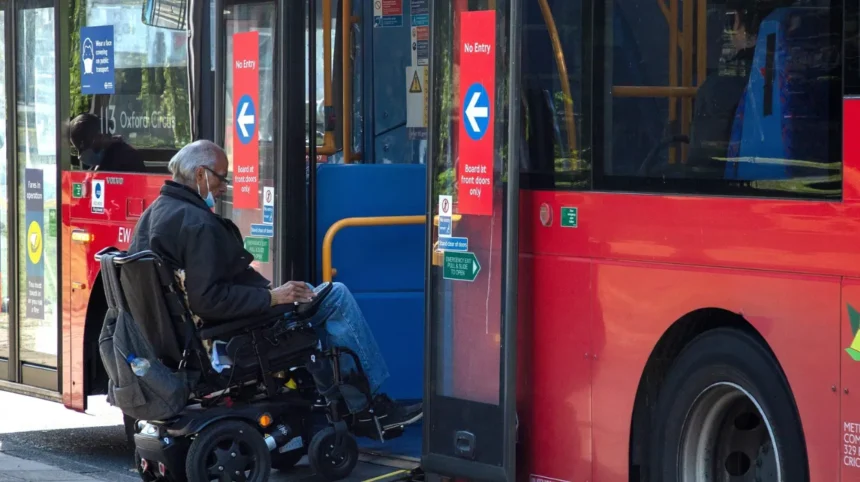
Buses provide a dedicated wheelchair priority area. Ealing Council explains that this space is the only location on its buses where wheelchair users can travel safely. Buggy users and other passengers can use the space when it is not required by a wheelchair user, but they must make room when a wheelchair passenger boards.
Accessible black cabs are another important option. TfL states that all London black cabs have wheelchair ramps. Some private-hire vehicles also provide step-free access.
The London Taxicard provides subsidised door-to-door transport for eligible people with serious mobility difficulties or severe sight impairment. Richmond upon Thames describes the service as subsidised transport using licensed black taxis and private-hire vehicles.
Dial-a-Ride is a free, bookable door-to-door transport service for eligible people with long-term disabilities. Hounslow Council includes it among its transport services for disabled and older residents.
These services are particularly important for journeys involving multiple inaccessible interchanges, long walking distances or locations away from major transport hubs.

How can you plan an accessible journey across West London?
An accessible West London journey should be planned from the starting address to the final entrance, checking step-free stations, walking distances, lifts, vehicle access, disruptions and alternative routes before departure. TfL’s journey planner provides accessibility filters for this process.
TfL recommends planning step-free journeys in advance and checking travel information before departure because accessibility can be affected by service disruption.
The TfL Go app and Journey Planner allow passengers to choose accessibility-related preferences. Users can specify whether they can use stairs or escalators, how far they want to walk and which transport modes they prefer.
A reliable accessibility check should cover five stages.
First, check the starting point. A station can be accessible while the pavement leading to it contains steep slopes, narrow sections or temporary works.
Second, check the transport interchange. A journey with one step-free station can become inaccessible if the connection requires stairs.
Third, check the destination entrance. Large attractions often have separate accessible entrances or dedicated routes.
Fourth, check facilities. An accessible toilet, seating area or changing facility can affect the practical length of a visit.
Fifth, check live disruptions. Lift failures and engineering works can change an accessible route.
Ealing Council also recommends TfL journey-planning tools and offers travel mentoring for people who feel uncertain about using public transport independently. The council states that its travel mentoring service is free and supports people with planning and completing journeys around London.
Which West London attractions have strong accessibility facilities?
West London includes several major attractions with established accessibility programmes, including Kew Gardens, Osterley Park and House and Ham House and Garden. Facilities include accessible paths, wheelchairs, mobility equipment, accessible toilets, ramps, sensory activities and assistance-dog access.
Kew Gardens is one of the strongest examples. The Royal Botanic Gardens, Kew states that its Gardens are largely flat, with many areas accessible through tarmac paths. Wheelchairs are available to borrow at entrance gates, while mobility scooters can be booked in advance.
Kew also provides accessible toilets across the Gardens. Its Brentford Gate includes a Changing Places toilet, designed for people who require additional space and specialist equipment.
Sensory accessibility is also part of Kew’s programme. The Gardens offer sensory tours for visitors with visual impairments and their carers. These tours use touch, smell and description and include free entry for eligible participants and essential carers.
Osterley Park and House, managed by the National Trust, provides accessible toilets, an accessible route and map, assistance-dog access, designated Blue Badge parking and an induction loop. Mobility equipment includes an outdoor wheelchair and powered mobility options.
The National Trust identifies an all-ability trail at Osterley using hard paths suitable for pushchairs, wheelchairs and cycles.
Ham House and Garden in Richmond provides an accessible toilet, a ramp to the ground floor and wheelchairs to borrow. Its historic character creates specific limitations. Upper floors are accessible only by stairs, while parts of the garden use gravel and cobbled surfaces.
This distinction is important. A heritage attraction can offer meaningful accessibility without every historic room or structure being physically accessible.

How accessible are parks and outdoor spaces in West London?
West London’s parks provide varied accessibility, with hard-surface paths, level routes, accessible toilets and mobility equipment at selected sites. Outdoor access differs by terrain, so visitors should check individual route surfaces, gradients, gates, seating and facilities before travelling.
Outdoor accessibility depends heavily on ground conditions.
Hard-surface paths generally provide more predictable wheelchair movement than grass, gravel or cobbles. Flat routes also reduce the physical effort required by manual wheelchair users and people with walking difficulties.
Osterley Park demonstrates how an accessible outdoor route can be incorporated into a historic landscape. The National Trust describes its all-ability trail as using hard paths suitable for wheelchairs, pushchairs and cycles.
Kew Gardens provides another model. Its Gardens are largely flat and contain extensive tarmac paths. This creates broad access across a large botanical landscape.
Outdoor accessibility still requires checking weather and temporary conditions. Wet grass, loose surfaces and temporary construction can change the practical accessibility of an otherwise suitable route.
Visitors should also consider seating. A route can be technically accessible but difficult for people who need frequent rest points.
What accessibility support is available for sensory disabilities?
West London accessibility includes support for people with visual, hearing and sensory-processing needs through hearing loops, audio descriptions, tactile resources, sensory tours, large-print information, BSL support and quieter visiting opportunities at selected venues.
Visual accessibility includes more than ramps and lifts. Large-print maps, tactile maps, audio descriptions and guided sensory experiences provide alternative ways to understand physical spaces and cultural exhibits.
Kew provides tactile maps and accessible trail information for selected programmes. Its Henry Moore accessible programme includes touch tours, audio descriptions and tactile maps designed for visitors with visual impairments.
Hearing accessibility includes induction loops, captioning and alternative communication. Brent Council states that its offices provide audio induction loops and can arrange a British Sign Language interpreter when visitors contact the council in advance.
Sensory accessibility also addresses environmental factors. Noise, crowds, lighting and unexpected changes can create barriers for people with autism or sensory-processing differences.
Kew provides out-of-hours access events for people who benefit from quieter visits, including people with autism spectrum conditions or sensory-processing differences.
These services show why accessibility planning needs to account for different disability requirements rather than treating wheelchair access as the only standard.
What accessible parking and Blue Badge services are available in West London?
Blue Badge parking provides important access for eligible disabled drivers and passengers by allowing parking closer to destinations. West London boroughs provide information about Blue Badge applications, disabled bays and related parking arrangements through their local transport services.
The Blue Badge scheme provides parking concessions for eligible people with disabilities or mobility difficulties. It is particularly important where public transport is difficult or a destination sits far from an accessible station.
Brent Council provides information about Blue Badge parking and disabled parking bays. Eligible residents can also apply for a disabled parking bay near their home under local rules.
Richmond upon Thames includes Blue Badges within its accessible travel services alongside Taxicard and Freedom Pass information.
Parking arrangements differ between boroughs and individual attractions. A Blue Badge does not automatically guarantee a space directly outside every venue.
Osterley Park, for example, provides designated Blue Badge parking as part of its accessibility facilities.
Ham House has extremely limited Blue Badge parking on site and recommends advance arrangements.
This makes advance checking essential when driving to West London attractions.
What financial and travel support is available for disabled people in West London?
Disabled people in West London can access several transport-support schemes, including Disabled Persons Freedom Passes, Taxicard, Dial-a-Ride, community transport and mobility services. Eligibility depends on disability, mobility, residence and individual scheme requirements.
The Disabled Persons Freedom Pass provides eligible London residents with free travel on most London public transport. Brent Council states that it covers London buses, Underground, Overground, DLR and Tramlink, with additional discounts on riverboat and cable-car services.
Eligibility includes several disability-related criteria. These include severe sight impairment, profound or severe deafness and certain qualifying benefits or mobility and communication assessment outcomes.
The Taxicard provides subsidised taxi travel for eligible residents with serious mobility or visual impairments who have difficulty using mainstream public transport.
Community transport provides another layer of support. Ealing Council lists community transport, Freedom Pass and Taxicard among its services for people who have difficulty walking or using public transport.
Hounslow provides travel training for people with physical disabilities, autism, mental health conditions and long-term conditions. The service focuses on building confidence for independent travel.
How accessible are West London’s council and digital services?
West London councils increasingly provide accessible websites, alternative communication formats, assistive technology support and accessible customer services. Digital accessibility includes keyboard navigation, screen-reader compatibility, readable text, alternative formats and accessible contact methods.
Accessibility applies to public information as well as physical buildings.
The Public Sector Bodies (Websites and Mobile Applications) Accessibility Regulations 2018 establish accessibility requirements for relevant public-sector websites and applications.
Brent Council’s accessibility statement identifies support for keyboard navigation, speech recognition and screen readers. Its customer portal is designed to allow text enlargement up to 300% without text spilling off the screen.
Richmond upon Thames provides accessible formats for some council information. Its registration services identify large-print material and Braille as available formats on request. The relevant office also provides level access and adapted toilet facilities.
Digital accessibility matters before a journey begins. A visitor needs to access opening times, transport information, booking systems, access guides and contact details.
An inaccessible booking system can become a practical barrier even when the physical venue itself is accessible.
How does the Equality Act protect accessibility in West London?
The Equality Act 2010 requires organisations covered by disability discrimination duties to make reasonable adjustments in relevant circumstances. Public-sector bodies also have anticipatory responsibilities, meaning accessibility needs should be considered before individual disabled people encounter barriers.
The Equality Act 2010 is the UK’s principal anti-discrimination law covering disability.
Reasonable adjustments can include physical alterations, communication support, changes to policies and staff training. Government guidance gives examples such as ramps, lifts, wide doors and tactile signage.
The anticipatory duty is particularly important for public services. Public organisations should consider the needs of disabled people in advance instead of waiting for a disabled person to request an adjustment.
For visitors, this framework supports the expectation that accessibility should form part of normal service planning.
For businesses and attractions, accessibility is therefore not simply a marketing feature. It forms part of the wider legal and service environment governing access to goods, facilities and services.
How are West London boroughs improving accessibility?
West London boroughs are developing accessibility through transport strategies, community transport, travel training, accessible parking, mobility support and improved public information. Richmond’s Transport Strategy 2040 places accessibility and connectivity at the centre of its long-term transport planning.
Richmond upon Thames approved its Transport Strategy 2040 in March 2026. The strategy sets a long-term direction for transport across the borough and specifically identifies accessibility and connectivity as priorities.
The strategy recognises that some neighbourhoods, including Ham, Hampton and Heathfield, have historically experienced weaker public transport connections. Improving links between neighbourhoods, town centres and services is therefore part of its long-term approach.
Other boroughs use more targeted services.
Hounslow provides travel training, ShopMobility and Dial-a-Ride information for people with additional transport needs.
Ealing provides transport advice, community transport, Taxicard information and travel mentoring.
Brent provides information covering Blue Badges, disabled parking bays, Freedom Passes, Taxicard, community transport and mobility equipment.
These approaches demonstrate that accessibility is delivered through multiple layers rather than through a single project.
Explore ore Area Guide
West London Bus Routes: TfL Guide to Key Services
Cycling Around West London: Routes & Guide 2026
What should visitors check before an accessible trip to West London?
Visitors should check transport access, station lifts, walking distances, venue entrances, accessible toilets, parking, assistance services and live disruptions before travelling. Individual access requirements should be confirmed directly with the venue when detailed facilities are important.
Start with the journey.
Use TfL’s journey planner to identify step-free options and minimise unnecessary walking. Check the current network status before departure.
Next, check the venue.
Look for the accessible entrance, route surface, lift availability, toilet facilities and seating. Historic buildings often have different access arrangements for different floors.
Then check additional requirements.
Visitors with visual impairments can check for audio descriptions, tactile resources and sensory tours. Visitors with hearing impairments can check for induction loops, captions or BSL support.
Wheelchair users should check door widths, lift dimensions and mobility equipment requirements where these details affect access.
Finally, contact the venue when necessary. Advance communication is particularly useful for equipment loans, accessible parking, assistance, group visits and specialist programmes.
What does the future of accessibility in West London look like?
The future of accessibility in West London is centred on more step-free transport, better journey information, inclusive public services, accessible attractions, improved neighbourhood connectivity and broader recognition of sensory and communication needs alongside physical access.
Accessibility is becoming a network-wide issue rather than a single-building issue.
TfL continues to expand step-free access and provides accessibility maps, journey-planning tools and travel information. Its accessibility programme covers Tube, buses, rail, river services, taxis and other modes.
The Elizabeth line demonstrates the effect of designing a modern railway around step-free access. Its 41 stations provide street-to-platform step-free access.
Local authorities are also integrating accessibility into broader transport planning. Richmond’s 2040 strategy provides an example of accessibility being treated as a long-term connectivity objective rather than a separate specialist service.
Attractions are expanding accessibility beyond physical infrastructure. Kew’s programmes include sensory tours, tactile maps, audio description and quieter access opportunities.
The result is a broader definition of accessible West London. The strongest accessibility model combines step-free movement, reliable transport, accessible information, suitable facilities, trained staff and inclusive visitor experiences.
For residents and visitors, the practical lesson is clear: accessibility varies by route, venue and individual need. Advance planning using official transport and venue information provides the most reliable way to build an accessible West London journey.
What does accessibility in West London include?
Accessibility in West London includes step-free public transport, accessible buses, wheelchair-friendly attractions, accessible toilets, Blue Badge parking, hearing support, visual assistance, sensory services and accessible digital information.