Cycling around West London combines established Cycleways, riverside routes, canal towpaths, large parks, residential streets and connections to neighbouring boroughs. The area includes fulham/hammersmith/">Hammersmith, hounslow/chiswick/">Chiswick, Ealing, Brentford, Richmond, Hounslow, Acton, Kew, Twickenham and surrounding districts.
- What makes West London suitable for cycling?
- Which West London areas are best for cycling?
- Which West London cycling routes are best for leisure rides?
- Can you cycle through Richmond Park?
- How does the Grand Union Canal support cycling in West London?
- What is Cycleway 9 and why is it important for West London cycling?
- How should you plan a cycling journey around West London?
- Can you combine cycling with public transport in West London?
- What cycling equipment is useful for West London routes?
- What cycling rules and safety practices apply in West London?
- What are the main benefits of cycling around West London?
- How is the future of cycling developing in West London?
West London provides cycling opportunities for commuters, leisure riders, families and visitors. The landscape changes significantly across the area. Central districts have busy urban roads and protected cycling infrastructure. Further west, routes connect parks, waterways, suburban neighbourhoods and historic destinations.
Transport for London (TfL) manages London-wide transport policy and supports cycling infrastructure alongside individual London boroughs. Its Cycleways programme connects communities, businesses and destinations through routes that include quieter streets, protected sections, crossings and junction improvements. TfL also provides cycle maps and journey-planning tools for people travelling by bicycle.
Cycling in West London therefore works as both a transport option and a recreational activity. Riders can choose direct urban journeys, quieter residential routes, canal-side cycling or longer park-based rides.
What makes West London suitable for cycling?
West London is suitable for cycling because it combines Cycleways, quieter residential streets, canals, parks, riverside corridors and transport connections. Routes vary from protected urban infrastructure around Hammersmith and Brentford to recreational cycling in Richmond Park and along canal towpaths.
West London has several geographical advantages for cycling. The River Thames creates a long east-west corridor through districts including Hammersmith, Chiswick, Brentford and Richmond. The Grand Union Canal provides another important linear route through parts of the area.
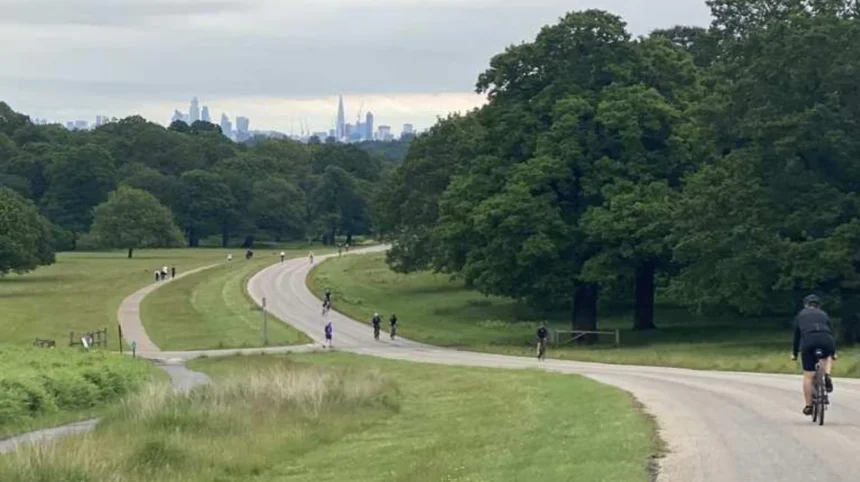
The western suburbs also contain substantial green space. Richmond Park is the largest of London’s Royal Parks, covering approximately 1,000 hectares, or 2,500 acres. Its perimeter is approximately 6.7 miles, providing a substantial setting for recreational cycling.
The urban structure also supports short-distance cycling. Residential areas connect to high streets, railway stations, schools, workplaces and parks. This makes cycling practical for journeys that do not require a car or lengthy public transport connection.
TfL’s cycling network is designed to connect neighbourhoods and destinations. Cycleways include routes on quieter roads and sections with physical separation from motor traffic. Junction improvements and pedestrian crossings form part of the wider cycling infrastructure.
West London also benefits from access to London’s wider cycle network. Riders can continue towards central London, North West London, Surrey and other parts of Greater London using connected streets and cycle routes.
Which West London areas are best for cycling?
Strong cycling areas include Richmond, Kew, Chiswick, Brentford, Hammersmith, Ealing, Hounslow and parts of Acton. Each area offers different cycling conditions, ranging from park routes and canal paths to protected infrastructure, residential streets and connections between major destinations.
Richmond is particularly important for recreational cycling because of Richmond Park and its surrounding roads. The park contains permitted cycling routes and the marked Tamsin Trail. Smaller pedestrian paths are not designated for cycling.
Kew provides connections between Richmond, Brentford, Chiswick and the River Thames corridor. The area is also close to Kew Gardens, although cycling access inside individual attractions follows their own rules.
Chiswick provides an important urban cycling corridor between Hammersmith, Brentford and central West London. Cycleway infrastructure has been developed along parts of the Chiswick High Road corridor.
Brentford sits between the River Thames and the Grand Union Canal. Its location creates links between waterway cycling, local streets and longer routes towards Hounslow and Ealing.
Hounslow provides connections further west. TfL has developed plans and infrastructure around the Cycleway 9 corridor connecting Brentford and Hounslow. A TfL proposal described 4.1 kilometres of new protected cycle lanes along London Road between Brentford and Hounslow, alongside improved crossings and connections.
Hammersmith provides an important western gateway towards central London. The borough contains major roads, residential districts, commercial areas and connections towards Chiswick and Fulham.
Ealing and Acton provide suburban cycling opportunities. Their streets connect residential neighbourhoods with railway stations, local centres and green spaces. Route conditions vary considerably, so riders should plan the specific journey rather than assume that every road has dedicated cycling infrastructure.
Which West London cycling routes are best for leisure rides?
The strongest leisure cycling routes include Richmond Park, Grand Union Canal paths, Thames-side connections and quieter streets linking Richmond, Kew, Chiswick, Brentford and Hounslow. These routes provide access to parks, waterways, historic districts, green spaces and local destinations.
Richmond Park is one of the most significant cycling destinations in West London. The Royal Parks permits cycling on specified larger roads and on the marked Tamsin Trail. Smaller paths and tracks are reserved for pedestrians.
The park provides a large recreational environment without requiring riders to leave Greater London. Its landscape includes grassland, woodland, ponds and wildlife habitats. The Royal Parks identifies Richmond Park as a National Nature Reserve and Site of Special Scientific Interest.
The Grand Union Canal provides another important leisure corridor. TfL has previously identified a West London cycling route between Paddington and Uxbridge along the Grand Union Canal, including the former Quietway 16 route.
Canal cycling requires a different approach from road cycling. Canal & River Trust states that permits are not required for cycling on its towpaths. It also asks cyclists to give priority and consideration to pedestrians, wildlife and people using the waterway.
The Thames corridor provides another useful recreational framework. Routes around Richmond, Kew, Chiswick and Brentford allow cyclists to combine riverside sections with public roads and local cycle infrastructure.
A leisure ride can therefore be planned according to distance and terrain. A short ride can focus on a park or local canal section. A longer ride can connect multiple West London districts.
Can you cycle through Richmond Park?
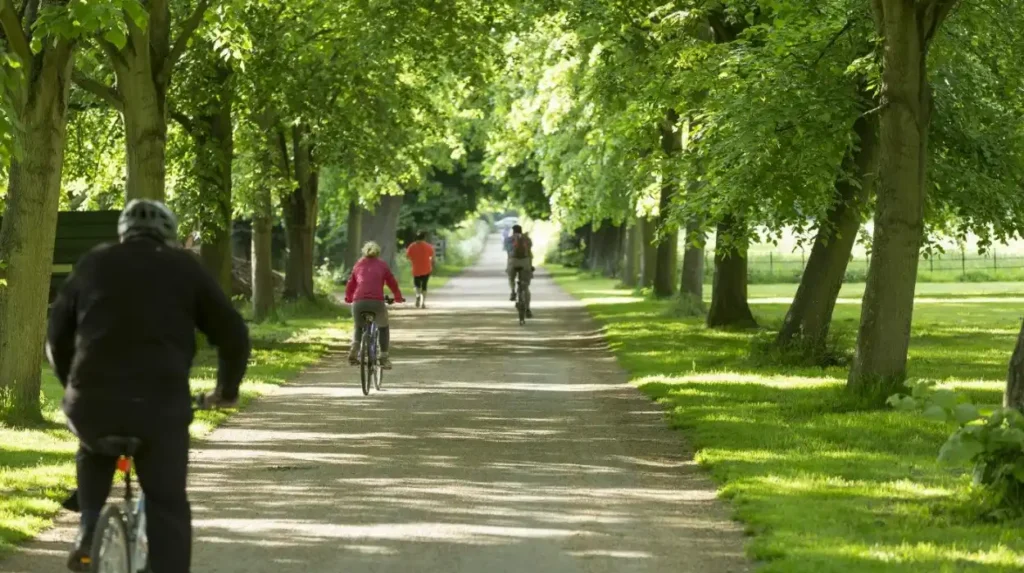
Yes, cycling is permitted in Richmond Park on designated roads and the marked Tamsin Trail. Cyclists must not use pedestrian-only paths and must respect pedestrians, wildlife, traffic restrictions and park regulations while riding through this protected natural landscape.
Richmond Park is a major cycling destination because of its size and distinctive road network. The park covers approximately 1,000 hectares and has a perimeter of about 6.7 miles.
Cyclists can use larger roads where cycling is permitted, including Queen’s Road, Sawyer’s Hill and Broomfield Hill. The Tamsin Trail provides the principal marked off-road cycling trail within the park.
The distinction between cycling routes and pedestrian paths is important. The park contains numerous walking tracks that are not cycling routes. Riders must remain on permitted roads and marked cycling infrastructure.
Wildlife is another major consideration. Richmond Park contains wild deer and other species. The Royal Parks asks cyclists to respect wildlife and other visitors and to control speed.
Richmond Park also provides cycle hire. Parkcycle operates from the Roehampton Gate car park and offers mountain bikes, child seats and junior bikes. Helmets are included with the hire service.
The park is therefore suitable for different cycling purposes. Experienced riders use its roads for training and longer rides. Families can use appropriate routes while following park rules. Visitors can combine cycling with the wider Richmond area.
How does the Grand Union Canal support cycling in West London?
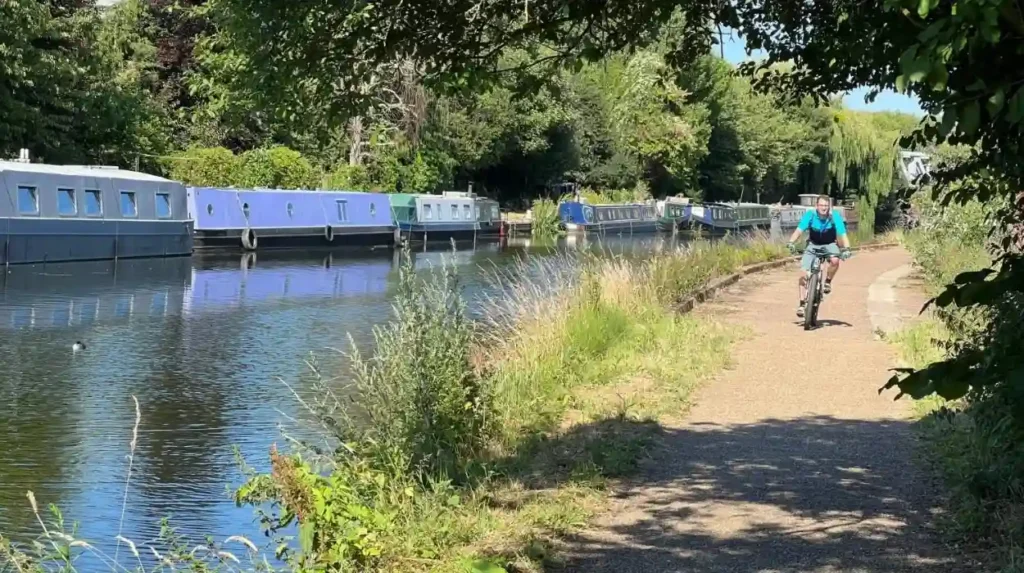
The Grand Union Canal provides a continuous waterway corridor through West London and supports recreational and utility cycling. Its towpaths connect neighbourhoods and green spaces, but cyclists must share the space responsibly with pedestrians, boat users and other canal visitors.
The Grand Union Canal is one of the most distinctive cycling corridors in West London. It links urban neighbourhoods with waterways, industrial heritage, residential areas and green spaces.
TfL has highlighted the route between Paddington and Uxbridge as a local cycling connection. The former Quietway 16 route followed the Grand Union Canal through West London.
Canal towpaths operate differently from conventional roads. They are often shared spaces rather than dedicated cycle tracks. Canal & River Trust explains that most of its towpaths are permissive paths rather than public rights of way. Maintenance closures can also occur.
Cyclists therefore need to manage speed and positioning carefully. Canal & River Trust does not specify a general towpath speed limit. Instead, it asks users to exercise common sense and give primary consideration to pedestrians and people handling boats.
The canal is particularly useful for leisure riders who want a route separated from busy arterial roads. However, surface conditions and shared use require attention. Riders should check current conditions and closures before setting out.
The Grand Union Canal also connects with other West London destinations. Brentford provides a significant link between the canal and the River Thames. From there, cyclists can plan routes towards Hounslow, Kew, Richmond or central London.
What is Cycleway 9 and why is it important for West London cycling?
Cycleway 9 is an important West London cycling corridor linking areas around Hammersmith, Chiswick, Brentford and Hounslow. Its development includes protected cycling infrastructure, junction improvements, crossings and connections designed to make everyday cycling safer and more direct.
Cycleway 9 forms part of London’s wider Cycleways network. TfL and London boroughs use Cycleways to connect communities and destinations through a combination of protected infrastructure and lower-traffic streets.
The West London section has particular importance because it connects several densely populated and commercially active districts.
TfL announced plans in January 2022 for a Cycleway 9 extension between Brentford and Hounslow. The proposal included 4.1 kilometres of protected cycle lanes along London Road. It also included a new cycle connection to Brentford Dock and the Grand Union Canal.
The same programme included signalised junction improvements, pedestrian crossings and connections around Spur Road and Twickenham Road. These elements demonstrate that cycling infrastructure involves more than painted lanes.
Protected routes separate cyclists from motor traffic where space and design allow. Junction treatments address locations where cyclists and vehicles interact. Crossings improve movement between cycling routes and surrounding neighbourhoods.
For everyday cyclists, these improvements are significant because directness and safety influence whether cycling works as a practical transport mode.
The wider Cycleway programme also continues to develop. TfL’s cycling action planning identifies further West London work, including Cycleway 9 West between Hounslow and Brentford.
How should you plan a cycling journey around West London?
A West London cycling journey should be planned around route type, distance, traffic conditions, cycling infrastructure, weather, daylight, access restrictions and the destination. TfL’s cycle maps and journey planner provide current route information for choosing practical cycling connections.
Route planning is essential because West London contains very different cycling environments. A route through Hammersmith has different conditions from a route through Richmond Park or along a canal towpath.
TfL provides cycle maps showing cycling routes and local networks. Its journey-planning tools allow users to select cycling and cycle-hire options when planning journeys.
The first planning decision is the purpose of the ride. Commuters generally prioritise directness and predictable journey times. Leisure riders often prioritise parks, waterways and quieter streets. Families require routes that suit children’s cycling abilities.
The second consideration is distance. Short journeys between local centres can use ordinary cycle infrastructure and quieter streets. Longer journeys require attention to rest points, bike condition, food, water and return transport.
The third consideration is surface type. Road bikes perform differently from hybrid bikes and mountain bikes. Canal towpaths and park trails require appropriate tyres and riding technique.
Weather also affects route choice. Rain increases braking distances and can make towpaths slippery. Strong winds affect exposed riverside routes. Darkness reduces visibility and makes lighting essential.
Cyclists should also check temporary closures and construction activity. London’s transport infrastructure changes over time. A route that was suitable previously can contain temporary diversions or roadworks.
Can you combine cycling with public transport in West London?
Yes, cycling can be combined with London public transport, but rules differ between folded and non-folded bicycles. Folded cycles are generally permitted across TfL services, while full-size cycles have specific restrictions on Tube, rail, bus, tram and other services.
Transport for London provides specific rules for carrying bicycles on public transport. Folded bicycles, including folded e-bikes, can generally be carried across almost all TfL services, although bus drivers can refuse boarding when services are too busy.
Non-folding e-bikes have stricter rules. TfL states that non-folding e-bikes are not permitted on most TfL services, including the Tube, Overground, Elizabeth line and DLR.
Non-folded conventional bicycles are permitted on specified Tube lines and sections at certain times. On listed services, they are allowed on weekdays before 07:30, between 09:30 and 16:00, and after 19:00. They are also allowed at any time on weekends and bank holidays, subject to the applicable service rules.
The District line is particularly relevant to West London because full-size bicycles are permitted on the line under TfL’s stated cycle conditions. The Central line also permits full-size cycles between White City, Ealing Broadway and West Ruislip under the listed restrictions.
Non-folded bicycles cannot be taken on London buses or trams. Most river services allow full-size cycles, but passengers should confirm the individual operator’s conditions before travelling.
These rules make mixed-mode journeys possible, especially when cyclists use a full-size bike for part of the journey and a permitted service for another section.
What cycling equipment is useful for West London routes?
Useful equipment for West London cycling includes a correctly fitted helmet, front and rear lights, reflective clothing, a lock, repair tools, spare inner tubes or puncture equipment, water and a charged phone. Equipment should match the route surface and journey length.
A reliable bicycle is the most important starting point. Brakes, tyres, chain, gears and lights should be checked before longer journeys.
Lights are particularly important for commuting during darker months. London cycling involves interaction with motor vehicles, pedestrians and other cyclists, so visibility is an important safety factor.
A strong lock is useful when stopping at stations, cafés, shops, parks and visitor attractions. Cycle parking availability differs between locations.
A basic repair kit should include tyre levers, a pump or inflator and puncture-repair equipment. Longer rides benefit from carrying a spare inner tube that matches the bicycle’s wheel size.
Water is essential for longer recreational rides, especially when cycling through large parks or along routes with limited facilities.
Navigation equipment is also useful. TfL’s cycling maps and journey planner provide route information, while a phone can provide additional navigation and live travel information.
Families should select appropriately sized bicycles and safety equipment for children. Richmond Park’s cycle hire provider offers junior bikes and child seats, demonstrating that family cycling is supported within major West London recreational destinations.
What cycling rules and safety practices apply in West London?
Cyclists in West London must follow road signs, traffic signals, cycle restrictions and local route rules while giving appropriate consideration to pedestrians and other road users. Park and canal cycling also requires compliance with site-specific conditions, access rules and shared-space etiquette.
Cyclists are road users and must follow applicable traffic regulations. Traffic signals, one-way systems, cycle lanes and prohibited movements apply according to the specific road design.
West London’s cycling environment includes busy roads, protected lanes, shared paths and residential streets. Riders should select their position according to the infrastructure provided.
Junctions require particular attention. Many collisions and conflicts occur where different transport movements intersect. Cyclists should follow signals and make their intentions clear.
Park rules are separate from general road rules. Richmond Park restricts cycling to designated roads and the Tamsin Trail. Pedestrian-only paths cannot be used for cycling.
The Royal Parks operates a cycling code of conduct across its sites. It states that pedestrians have priority and that cyclists must balance their use of park routes with the needs of other visitors.
Canal towpaths also require responsible riding. Canal & River Trust asks cyclists to give consideration to pedestrians, wildlife and people handling boats.
Speed should reflect the environment. A fast pace suitable for an open road is inappropriate on a crowded towpath or shared park path.
Courtesy is particularly important on shared infrastructure. Slowing down, giving audible warning where appropriate and allowing pedestrians sufficient space reduces conflict.
Explore More Area Guide
Best West London Areas Near Tube Stations 2026
Parking in West London: Complete Guide for Drivers 2026
What are the main benefits of cycling around West London?
Cycling around West London provides transport, exercise, recreational and environmental benefits. It connects residential areas with workplaces, stations, parks, waterways and local centres while supporting active travel and reducing dependence on private motor vehicles for suitable short and medium-distance journeys.
Cycling provides an efficient option for many local journeys. It does not require parking at the destination and avoids some congestion experienced by motor traffic.
TfL’s wider transport objective is to increase the proportion of journeys made by walking, cycling and public transport. Its stated target is for 80% of journeys in London to use these modes by 2041.
Cycling also supports physical activity. Regular active travel integrates movement into everyday journeys rather than requiring separate travel to an exercise facility.
The environmental impact is also relevant. Replacing suitable car journeys with bicycle journeys reduces direct vehicle emissions and road-space demand.
West London’s parks provide an additional recreational benefit. Richmond Park offers approximately 2,500 acres of landscape for outdoor activities, including cycling.
Cycling also supports access to local economies. Riders can reach high streets, cafés, shops, cultural attractions and visitor destinations without requiring car parking.
The combination of transport and recreation makes cycling relevant to both residents and visitors. A single cycling network can support commuting during the week and leisure rides at weekends.
How is the future of cycling developing in West London?
The future of West London cycling centres on expanding Cycleways, improving protected infrastructure, connecting existing routes, upgrading junctions and integrating cycling with public transport. Projects around Hounslow, Brentford and other western corridors demonstrate continued investment in active travel infrastructure.
West London’s cycling network continues to evolve through borough and TfL programmes. Cycleways form the core strategic approach for connecting neighbourhoods and destinations.
The planned and developing Cycleway 9 corridor demonstrates the direction of infrastructure investment. TfL’s West London proposals included protected lanes, junction improvements, crossings and connections to waterways.
TfL’s cycling action planning also identifies Cycleway 9 West between Hounslow and Brentford among planned network development.
Future cycling conditions therefore depend on both new infrastructure and the integration of existing routes.
Better connections between residential areas, stations, parks and employment centres can make cycling more practical for everyday journeys.
The expansion of protected infrastructure is particularly important on busy roads. Physical separation reduces direct interaction between bicycles and moving motor traffic where appropriate.
Integration with public transport will also remain important. TfL’s bicycle rules already allow certain combinations of cycling and rail or Tube travel. Folded bicycles provide the greatest flexibility across the network.
West London’s long-term cycling network will therefore consist of different route types rather than one continuous facility. Protected Cycleways, quiet residential streets, canal corridors, park roads and public transport connections each serve different journey requirements.
For residents and visitors, the practical approach is to select the route according to purpose, distance, infrastructure and current access conditions.
Cycling around West London is consequently a broad transport and leisure activity. Richmond Park provides a major recreational destination. The Grand Union Canal provides an important linear corridor. Cycleways provide strategic urban connections. Thames-side routes link several western districts.
Together, these elements create a diverse cycling environment across West London. Using current TfL maps, following local access rules and choosing equipment appropriate for each route allows cyclists to navigate the area efficiently and responsibly.
Is West London good for cycling?
Yes. West London has a varied cycling network covering protected Cycleways, quieter residential streets, canal towpaths, riverside routes and large parks. Areas such as Richmond, Kew, Chiswick, Brentford and Hounslow provide different cycling environments.