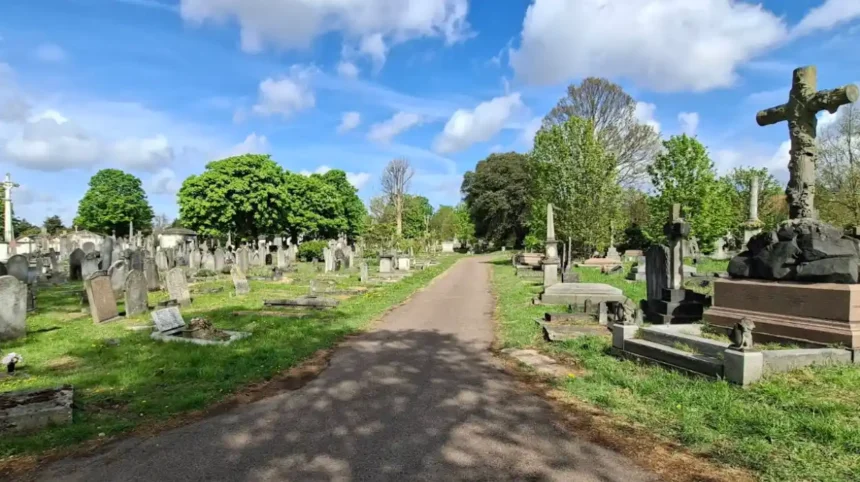
Kensal Green Cemetery is London’s first and most prestigious Victorian garden cemetery, opened in 1833 as the originator of the “Magnificent Seven.” This 72-acre Grade I listed burial ground in West London houses over 250,000 interments across 65,000 graves, including royals, engineers like Isambard Kingdom Brunel, writers such as William Makepeace Thackeray, and Queen’s frontman Freddie Mercury (cremated).
- What is Kensal Green Cemetery and why does it matter to London history?
- Who are the notable people buried at Kensal Green Cemetery?
- What makes Kensal Green one of the Magnificent Seven cemeteries?
- How is Kensal Green Cemetery architecturally designed and what structures can visitors see?
- What wildlife and natural features make Kensal Green a conservation area?
- How do you visit Kensal Green Cemetery and what are the opening hours and costs?
- Why is Kensal Green Cemetery London’s best hidden gem for West London visitors?
What is Kensal Green Cemetery and why does it matter to London history?
Kensal Green Cemetery is London’s first commercial garden cemetery, opened in 1833 as the originator of the “Magnificent Seven” Victorian burial grounds. It was founded by barrister George Frederick Carden, inspired by Paris’s Père Lachaise Cemetery, and consecrated by the Bishop of London on 24 January 1833. The cemetery spans 72 acres (29 hectares) across the borders of Kensington & Chelsea and fulham/hammersmith/">Hammersmith & Fulham in West London, containing over 140 listed buildings and monuments.
Kensal Green solved London’s critical burial crisis. By the early 1800s, urban parish burial grounds were dangerously overcrowded following cholera epidemics and population growth. The Metropolitan General Cemetery Act 1832 (2 & 3 Will. 4. c. cx) authorized the General Cemetery Company to raise £45,000 in shares and purchase up to 80 acres. The company bought 54 acres at Kensal Green for £9,500 in 1831. This necropolis became the model for cemeteries throughout the British Empire, including Sydney’s Rookwood Necropolis (1868) and Waverley Cemetery (1877).
The cemetery remains operational today under its original Act of Parliament, which prohibits exhumation, cremation-reburial, or land sale for development. When interment space exhausts, it must become a memorial park.
Who are the notable people buried at Kensal Green Cemetery?
Kensal Green Cemetery contains graves of over 500 British nobility members, 970 Dictionary of National Biography entries, and iconic figures including engineers Brunel, writer Thackeray, playwright Harold Pinter, and Queen’s Freddie Mercury (cremated). The cemetery holds approximately 250,000 individuals in 65,000+ graves, with remarkable concentration of Royal Society Fellows.
Royal burials include Prince Augustus Frederick, Duke of Sussex (son of King George III, buried 1843), Princess Sophia (George III’s daughter), and Prince George, Duke of Cambridge (grandson of George III, Army commander-in-chief). The Duke of Sussex’s burial here instead of a traditional royal state funeral made Kensal Green fashionable for society.
Engineers and scientists buried include:
- Isambard Kingdom Brunel (1806–1859), engineer of the Great Western Railway, Clifton Suspension Bridge, and SS Great Eastern, with his father Marc Isambard Brunel (1769–1849)
- Charles Babbage (1791–1871), mathematician and “father of computing,” FRS
- Joseph Locke (1805–1860), civil engineer
- Carl William Siemens (industrialist)
Authors and playwrights include:
- William Makepeace Thackeray (1811–1863), author of Vanity Fair
- Anthony Trollope (1815–1882), novelist
- Wilkie Collins (1824–1889), author
- Harold Pinter (1930–2008), playwright and actor
- Thomas Hood (1799–1845), poet and humorist
Artists and architects include:
- Decimus Burton (1800–1881), architect
- Philip Hardwick (1792–1870), architect
- George Cruikshank, illustrator
- William Mulready, artist
Entertainers include:
- Charles Blondin (1824–1897), French acrobat famous for crossing Niagara Falls on a tightrope
- Andrew Ducrow (1793–1842), circus owner
- Charles Kemble (1775–1854), actor
- Fanny Kemble (1809–1893), actress and author
- Alexis Soyer (1810–1858), chef and humanitarian
Notable cremations at the West London Crematorium (within cemetery grounds):
- Freddie Mercury (1946–1991), Queen frontman, commemorated by plinth near his birth name Farrokh Bulsara
- Alan Rickman (1946–2016), actor
- Ingrid Bergman (1915–1982), actress
- Joe Strummer (1952–2002), Clash singer-songwriter
- Dame Sarah Oram (1860–1946), senior military nurse
The cemetery also contains the cenotaph of Robert Owen (1771–1858), industrialist and social reformer who originated infant schools and reduced factory labor hours for women and children. The Reformers’ Memorial (erected 1885) lists over 70 radicals including John Stuart Mill, William Morris, and Elizabeth Fry.
What makes Kensal Green one of the Magnificent Seven cemeteries?
The “Magnificent Seven” are seven large private Victorian cemeteries in London created to replace overcrowded parish burial grounds, with Kensal Green as the first opened in 1833. The term is informal but historically significant. The seven cemeteries are Kensal Green, West Norwood, Highgate, Abney Park, Nunhead, Brompton, and Tower Hamlets.
Kensal Green differs from other Magnificent Seven cemeteries through its scale and status. It is the largest at 72 acres compared to Highgate’s 37 acres. Kensal Green holds Grade I listing on the Register of Historic Parks and Gardens (designated 1 October 1987, reference no. 1000817), the highest heritage designation. It was London’s first commercial cemetery and originator of the garden cemetery concept in Britain.
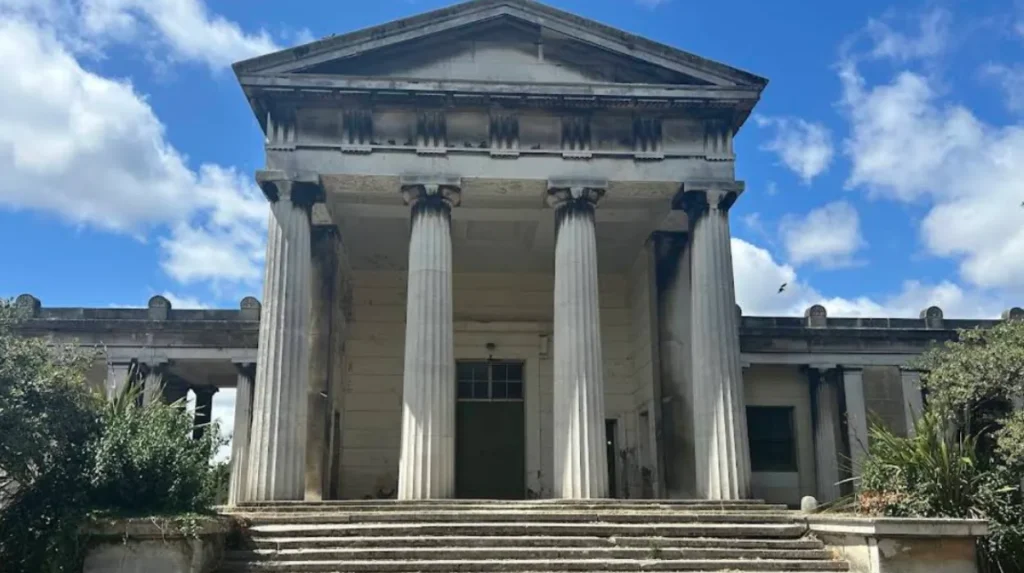
The cemetery’s design combines neo-classical buildings with richly planted grounds creating an “Arcadian landscape.” John Griffith of Finsbury designed the two chapels and gateway in Greek Revival style after the Chairman preferred this over Henry Edward Kendall’s original Gothic Revival competition winning design. The Anglican Chapel uses Doric order; the Dissenters’ Chapel uses Ionic order.
Kensal Green’s impact extended globally. It established the design and management basis for cemeteries throughout the British Empire, including self-sustaining management structures championed by the General Cemetery Company.
How is Kensal Green Cemetery architecturally designed and what structures can visitors see?
Kensal Green Cemetery features Greek Revival neo-classical chapels, Grade I listed Anglican Chapel with working catacomb, Grade II* Dissenters’ Chapel, eight Grade II* tombs, and 140+ listed monuments across 72 acres with two conservation areas. The layout follows an east-west axis with a central path leading to the raised Anglican Chapel.
The Anglican Chapel is Grade I listed and dominates the western section. It stands on a terrace beneath which lies an extensive catacomb (Catacomb B) with space for approximately 4,000 deposits. The chapel contains a working hydraulic catafalque (coffin-lift) restored by The Friends of Kensal Green Cemetery in 1997. The chapel was damaged during World War II but restored in 1954.
The Dissenters’ Chapel in the eastern corner is Grade II* listed. This Greek Revival structure served all non-Anglican denominations and non-believers. After becoming derelict and partly roofless, it underwent £447,000 restoration completed in May 1997 by the Historic Chapels Trust. It now serves as The Friends of Kensal Green Cemetery’s office and is available for funeral services.
The catacombs include three vaults:
- Catacomb A beneath North Terrace Colonnade (sealed)
- Catacomb Z beneath Dissenters’ Chapel (closed after WW2 bomb damage)
- Catacomb B beneath Anglican Chapel (operational, six aisles, vaults numbered 1-216)
Notable monuments include:
- Reformers’ Memorial (Grade II), erected 1885 by Joseph Corfield
- Tomb of Charles Spencer Ricketts (Grade II*), designed by William Burges
- Eight Grade II* listed tombs and memorials
The cemetery contains 140+ listed buildings and monuments, mature trees, varied grassland types, and vegetated masonry with diverse ferns, mosses, and lichens.
What wildlife and natural features make Kensal Green a conservation area?
Kensal Green Cemetery includes two Conservation Areas, supports 33 bird species, and contains rare wildflowers including great burnet, common bistort, sneezewort, and wall butterfly habitats across its 72 acres. Part of the site is managed as a nature reserve by the London Wildlife Trust, including the Grand Union Canal towpath section.
The cemetery was originally designed in the spirit of an English country park and now preserves formerly widespread countryside habitats within urban London. Large numbers of mature trees support colourful wildflowers across varied grassland types.
Rare plants in the rich grassland between gravestones include:
- Great burnet (regionally rare)
- Common bistort (regionally rare)
- Common valerian (regionally rare)
- Sneezewort (regionally rare)
- Pepper-saxifrage (regionally rare)
- Grey sedge (regionally rare)
Drier grassland in the north-west includes wild basil and rough hawkbit, both untypical of north London.
The breeding bird population includes tawny owl, spotted flycatcher, and chaffinch (unusual this far into London). Butterflies include the nationally declining wall butterfly.
The vegetated masonry habitat hosts diverse communities of ferns, mosses, and lichens. The cemetery adjoining the Paddington Arm of the Grand Union Canal has long been separated by a wall, with defunct gates in the southern wall where barges once unloaded earth from grave excavations and occasionally coffins.
Explore More Area Guide
Is Harlesden Safe for Tourists? Top 10 Things to Do in 2026
Weekend in Harlesden: 2-Day Food, Culture & Hidden Pubs Itinerary
How do you visit Kensal Green Cemetery and what are the opening hours and costs?
Kensal Green Cemetery is free to visit independently, open daily year-round with summer hours (April–September) Monday–Saturday 9am–6pm, Sunday 10am–6pm, and winter hours (October–March) Monday–Saturday 9am–5pm, Sunday 10am–5pm. Bank Holidays are 10am–1:30pm. The nearest tube station is Kensal Green.
The main entrance is on Harrow Road (west of where Ladbroke Grove and Chamberlayne Road meet). The West Gate entrance at Alma Place is almost opposite Greyhound Road on the north side, leading to the West London Crematorium and St. Mary’s Roman Catholic Cemetery. Postcode is NW10 5NU.
Guided tours are offered every Sunday from March to October, and the first and third Sundays of each month from November to February. Tours begin at the Anglican Chapel, lasting 2:00–4:00pm. The suggested donation is £7 per person, plus £5 additional for concessions afterwards. The catacomb under the Anglican Chapel can be visited as part of guided tours.
Public transport access:
- Nearest tube: Kensal Green Station (London Overground and Bakerloo line)
- Walk along Harrow Road to the main entrance
- The Masons Arms pub is on the left after Kensal Green Station
The gardens are open every day including weekends and bank holidays. Burials and cremations occur daily, though cremations are more common than interments now.
Why is Kensal Green Cemetery London’s best hidden gem for West London visitors?
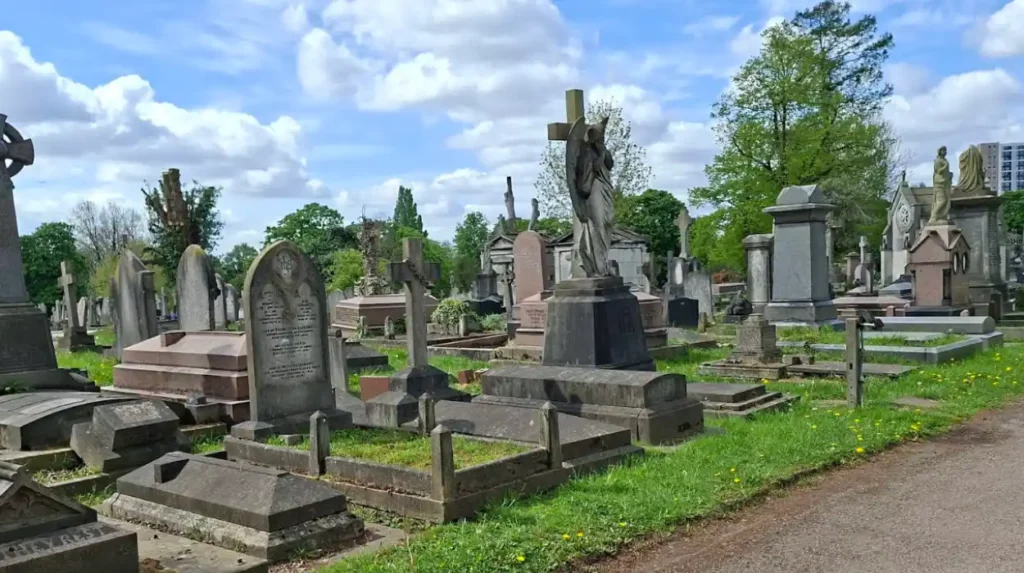
Kensal Green Cemetery is West London’s best hidden gem because it combines Grade I listed heritage, 250,000 interments including royals and iconic figures, 72 acres of conservation-area wildlife, free independent access, and guided tours revealing Victorian history unlike any other London location. Most London visitors never discover this functioning necropolis spanning Kensington & Chelsea and Hammersmith & Fulham.
The cemetery offers unique advantages over other London attractions:
| Feature | Kensal Green Advantage |
|---|---|
| Heritage status | Grade I listed parks and gardens (highest designation) |
| Notable burials | 500+ nobility, 970 DNB entries, Brunel, Thackeray, Mercury |
| Natural space | 72 acres with 2 conservation areas, 33 bird species |
| Cost | Free independent access; £7 tours |
| Accessibility | Kensal Green tube station, daily opening year-round |
| Authenticity | Still operational since 1833 under original Act of Parliament |
| Atmosphere | Gothic monuments with Grecian buildings, film location for Theatre of Blood |
G.K. Chesterton immortalized Kensal Green in “The Rolling English Road”: “Before we go to Paradise by way of Kensal Green.” The cemetery’s Gothic character (despite Grecian buildings) due to high numbers of private Gothic monuments created the atmosphere chosen for movie scenes.
The Friends of Kensal Green Cemetery (established 13 June 1989) organises tours, events, and published “Paths of Glory” detailing famous residents. This charitable organisation preserves, conserves, and restores the cemetery for public benefit.
For West London residents and visitors, Kensal Green provides quiet historical immersion, wildlife observation, architectural appreciation, and connection to Victorian Britain’s greatest thinkers—all without ticket queues or crowds. The cemetery’s mandate ensures it remains a memorial park when interment space exhausts, guaranteeing permanent public access to this extraordinary historical landscape.
What is Kensal Green Cemetery?
Kensal Green Cemetery is London’s first Victorian garden cemetery, opened in 1833 and recognized as the original of the Magnificent Seven cemeteries. It spans 72 acres in West London and contains over 250,000 interments.