West London contains one of the richest concentrations of historic houses, royal residences, landscaped estates, religious sites and architectural landmarks in Greater London. The area stretches across communities including Fulham, hounslow/chiswick/">Chiswick, Brentford, Ealing, Hounslow, Kew, Richmond and Twickenham, with the River Thames forming a major historical corridor.
- What makes West London historically important?
- Which West London landmarks represent royal history?
- How does Fulham Palace reveal the oldest layers of West London history?
- Why is Chiswick House important to British architectural history?
- What does Osterley Park reveal about Tudor and Georgian West London?
- Which West London landmarks represent Georgian culture and design?
- What makes Boston Manor House and Pitzhanger Manor historically significant?
- How have West London’s historic landmarks been preserved?
- Why should visitors explore historic landmarks across West London?
- What is the best way to understand West London’s historic landmarks?
The historic character of West London developed through several distinct periods. Prehistoric settlement, Roman activity, Anglo-Saxon estates, medieval religious ownership, Tudor royal power, Georgian architecture, Victorian expansion and modern conservation all shaped the landscape. The result is a varied collection of landmarks with different architectural styles and historical functions.
Historic landmarks in West London also demonstrate how London expanded beyond its medieval core. Country estates once stood outside the capital. Royal residences used the Thames as a transport route. Wealthy merchants and aristocrats established villas along the river. Later, railways, roads and suburban development transformed these districts into part of Greater London.
Several landmarks remain especially important because their buildings, gardens and archaeological remains preserve evidence from multiple periods. Fulham Palace represents more than 1,300 years of institutional history. Hampton Court Palace connects West London with Tudor and Stuart monarchy. Chiswick House represents early eighteenth-century Palladian architecture. Osterley Park preserves a Tudor estate transformed by Robert Adam. Strawberry Hill helped establish the Gothic Revival.
What makes West London historically important?
West London is historically important because its landmarks preserve royal, religious, architectural, agricultural and social history across more than 1,000 years, with major examples including Fulham Palace, Hampton Court Palace, Syon House, Chiswick House, Osterley Park and Strawberry Hill House.
The geographical position of West London explains much of this heritage. The River Thames provided transport, trade, agriculture and access to royal residences. Settlements developed around river crossings, estates and roads connecting London with western England.
Fulham Palace demonstrates the depth of the area’s history. Archaeological evidence at the site extends back thousands of years, while the Bishop of London acquired the manor in AD 704. The site later developed into a substantial moated ecclesiastical residence.
The Thames also encouraged the development of elite residential landscapes during the eighteenth century. Areas around Twickenham, Richmond, Kew and Hampton became attractive locations for people seeking proximity to the royal court while maintaining a residence outside central London.
The architectural record is equally significant. West London contains Tudor, Jacobean, Palladian, Georgian, Gothic Revival and neoclassical buildings. These styles represent changing ideas about power, domestic life, landscape design and cultural identity.
Historic preservation has also shaped the modern landscape. Listed-building protection, registered parks and gardens, conservation areas and charitable stewardship help retain buildings and landscapes within a rapidly expanding city.
Which West London landmarks represent royal history?
Royal history is strongly represented by Hampton Court Palace, Kew Palace and Syon House, which connect West London with Tudor monarchs, Georgian royalty and aristocratic families closely associated with the Crown and national political history.
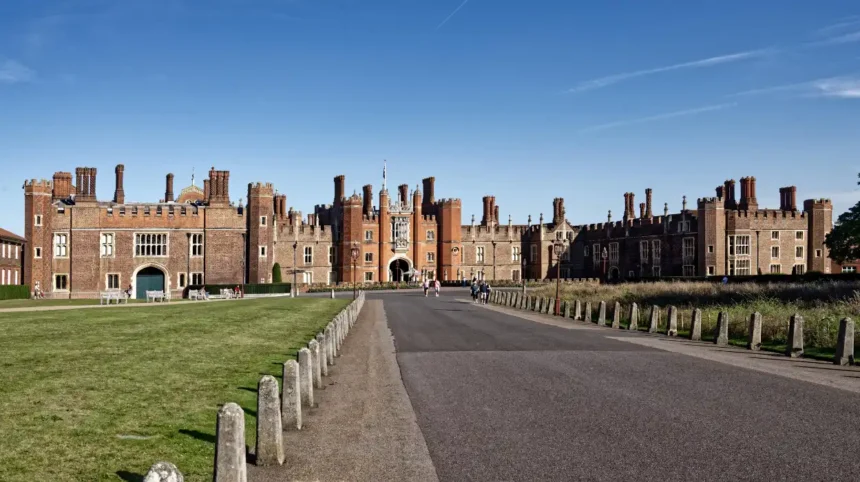
Hampton Court Palace is the most prominent royal landmark in this group. Its history began before Henry VIII, when Cardinal Thomas Wolsey transformed an earlier manor into a Renaissance palace. Henry VIII took control of the property in 1529 and expanded it substantially.
By the 1530s, Hampton Court had become a major centre of royal life. It contained state apartments, private rooms, kitchens, accommodation for courtiers and spaces for entertainment. The palace also functioned as a political and administrative centre because Tudor government operated closely around the monarch and royal household.
The palace later acquired a second architectural identity. William III and Mary II commissioned Sir Christopher Wren to construct a Baroque palace alongside the surviving Tudor structures after 1689. This created the unusual combination of Tudor and later classical architecture visible today.
Kew Palace provides a different form of royal history. The building was originally constructed in 1631 as a mansion for Samuel Fortrey, a wealthy London silk merchant. The Georgian royal family later adopted Kew as a private retreat. George III used the palace during periods of illness, while Queen Charlotte died there in November 1818.
Syon House in Brentford has an even broader historical association. Historic England lists Syon House as a Grade I listed building. The official record connects the site with Catherine Howard, Edward Seymour, Lady Jane Grey, Charles II and the Dukes of Northumberland.
These sites show that royal history in West London was not restricted to formal palaces. It also included private retreats, aristocratic residences and estates that supported the political and social structures surrounding the monarchy.
How does Fulham Palace reveal the oldest layers of West London history?
Fulham Palace reveals some of West London’s deepest historical layers because archaeological evidence records prehistoric, Roman, Anglo-Saxon, Viking and medieval activity before the site became the long-term residence of the Bishops of London from AD 704.
Fulham Palace occupies a strategically important location beside the River Thames. Archaeological investigations have identified evidence dating back thousands of years. Finds include prehistoric worked flint, Roman coins and pottery, building materials and evidence associated with earlier settlement.
The Roman period produced substantial archaeological evidence. Fulham Palace records Roman coins, pottery, construction material and possible evidence for a Roman villa near the present walled garden. The site therefore represents more than a medieval ecclesiastical residence.
In AD 704, Bishop Waldhere acquired the Manor of Fulham. The estate then covered a very large area, including parts of modern Hammersmith, Fulham, Acton, Ealing and Finchley. This acquisition established a relationship between the site and the Bishops of London that lasted for more than 1,300 years.
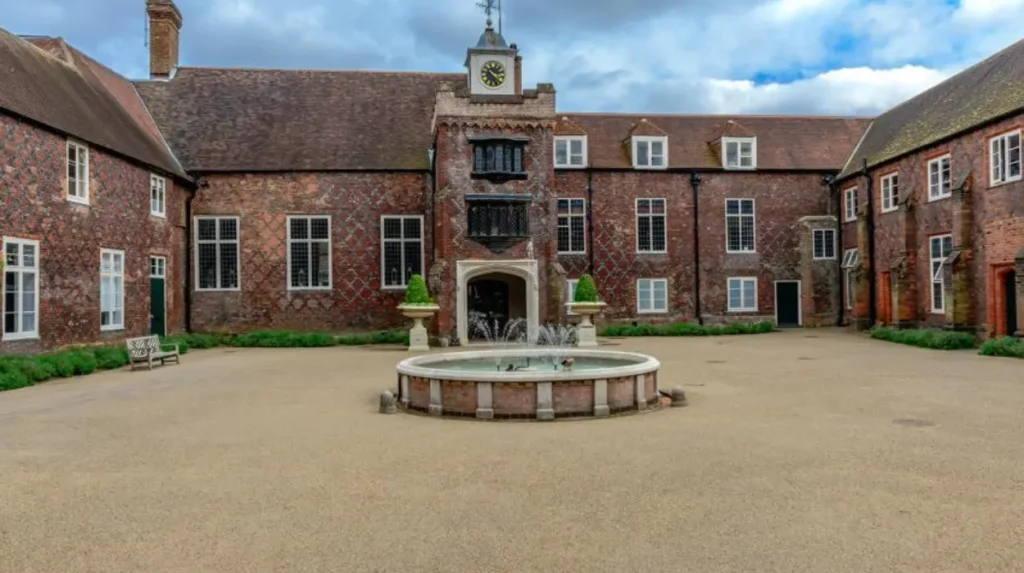
The medieval landscape developed around a large moat. Fulham Palace records state that the enclosed site reached 36 acres between 1066 and 1485, making it the largest domestic moated site in England according to the Palace’s historical interpretation.
The Tudor period added another major layer. The Tudor courtyard and great hall were constructed around 1495, based on dendrochronological analysis of surviving timbers. Later bishops altered the building according to changing architectural fashions and household requirements.
The site’s religious importance also connects it to major national events. The Bishops of London held significant political and ecclesiastical influence. Fulham Palace therefore provides a direct link between local West London history and wider English religious and political history.
Why is Chiswick House important to British architectural history?
Chiswick House is important because its 1726–1729 villa established an influential form of English neo-Palladian architecture, while its gardens helped develop the English landscape movement associated with Lord Burlington and designer William Kent.
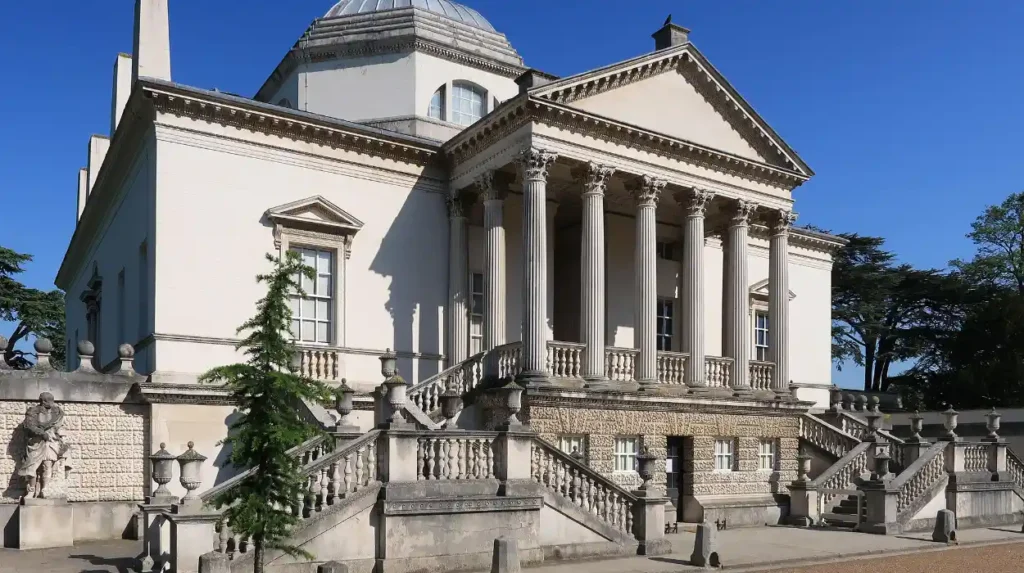
Chiswick House was created by Richard Boyle, the 3rd Earl of Burlington, an eighteenth-century aristocrat, architect and patron of the arts. Burlington drew heavily on Italian architecture, particularly the work of Andrea Palladio, whose classical principles influenced British architecture.
The villa was built between 1726 and 1729 after a fire damaged the existing house in 1725. Its design used classical forms associated with ancient Rome and Palladian architecture. The building has a square plan, a six-column portico and an octagonal dome over the central Saloon.
Chiswick House was not simply a domestic residence. Burlington used it as a setting for art, books and cultural activity. Its collections reflected his role as a major eighteenth-century patron. William Kent, a painter, architect and garden designer, also contributed to the interiors and furniture.
The surrounding landscape is equally important. Burlington began redesigning the gardens in 1716. William Kent later developed a more naturalistic approach that reduced the strict geometric character of earlier formal gardens. This approach became an important stage in the development of the English landscape garden.
The gardens included ornamental buildings, avenues, water features, sculptures and carefully arranged views. The landscape therefore operated as an extension of the architecture rather than simply as open land surrounding the house.
Chiswick House later experienced significant changes. The Dukes of Devonshire inherited the estate after Burlington’s death in 1753. In the nineteenth century, the house was leased as an asylum and hospital. After the estate was transferred to Middlesex County Council in 1929, restoration campaigns attempted to recover Burlington’s architectural vision.
The house and gardens now demonstrate how eighteenth-century architecture and landscape design influenced the wider development of British country-house culture.
What does Osterley Park reveal about Tudor and Georgian West London?
Osterley Park reveals how a Tudor country estate evolved into an eighteenth-century neoclassical mansion, with Sir Thomas Gresham establishing the estate in the 1560s and architect Robert Adam transforming the house for the Child family.
Osterley Park began as a Tudor estate associated with Sir Thomas Gresham, a prominent financier and founder of the Royal Exchange. Gresham acquired the estate in the sixteenth century and developed it into a substantial country property.
The National Trust records the estate’s origins in the 1560s. Gresham expanded the landholding, enclosed approximately 600 acres and improved the house. Queen Elizabeth I visited Osterley several times, demonstrating the property’s early connection with the Tudor court.
The estate changed substantially after Sir Francis Child acquired it in 1713. The Child family became associated with banking and the East India Company. Their wealth allowed Osterley to be transformed into a sophisticated eighteenth-century country residence.
Robert Adam began redesigning the house in the 1760s. Adam was one of Britain’s leading eighteenth-century architects and designers. His work created the neoclassical appearance that defines much of Osterley today. The interiors contain elaborate plasterwork, decorative schemes and carefully coordinated architectural details.
The wider estate also has considerable landscape significance. Osterley Park covers approximately 360 acres and contains lakes, lawns, meadows, formal gardens and working farmland. The National Trust describes it as one of London’s largest surviving historic villa estates.
Historic England records Osterley Park and House as a Grade I listed building. The National Trust Heritage Records also identify the surrounding landscape as a registered park or garden of special historic interest.
Osterley therefore illustrates a recurring West London pattern. A rural estate became an elite residence, then survived metropolitan expansion while retaining substantial historic architecture and landscape.
Which West London landmarks represent Georgian culture and design?
Marble Hill House and Strawberry Hill House represent two contrasting sides of Georgian West London: Marble Hill demonstrates Palladian classicism, while Strawberry Hill demonstrates Gothic Revival design and the cultural influence of Horace Walpole.
Marble Hill House stands beside the Thames in Twickenham. It was built in the 1720s for Henrietta Howard, a prominent figure in Georgian court society and a close associate of George II.
The house is an important example of Palladian architecture. Its design followed classical principles derived from Andrea Palladio and contemporary British interpretations of classical architecture. Henrietta Howard used the property as a retreat from court life and later made it her principal residence.
Marble Hill also demonstrates the social importance of eighteenth-century Thames-side villas. Henrietta Howard entertained writers, politicians and artists, including figures such as Alexander Pope and Horace Walpole. The surrounding landscape was designed as an integral part of the estate.
Its survival also represents an important episode in modern conservation. Development threatened Marble Hill in 1901. A public campaign opposed the proposed housing development. Parliament subsequently passed legislation in 1902 protecting the famous view from Richmond Hill. Marble Hill opened as a public park in 1903.
Strawberry Hill House presents a different architectural direction. Horace Walpole purchased the site in 1747 and transformed existing cottages into a Gothic-style villa. He described his ambition as creating a small Gothic castle, complete with battlements, pinnacles and a round tower.
Walpole’s house became an important early expression of the Gothic Revival. Its interiors drew inspiration from medieval architecture, including Gothic vaulting, tombs and decorative motifs. The building influenced the development of Gothic design during the eighteenth and nineteenth centuries.
Walpole was also the author of The Castle of Otranto, generally recognised as the first Gothic novel. His architectural and literary interests therefore reinforced each other and helped establish Gothic aesthetics as an important cultural movement.
What makes Boston Manor House and Pitzhanger Manor historically significant?
Boston Manor House and Pitzhanger Manor demonstrate two different phases of West London domestic architecture, with Boston Manor representing Jacobean design from 1623 and Pitzhanger reflecting Sir John Soane’s early nineteenth-century architectural experimentation.
Boston Manor House is a Grade I listed Jacobean manor house in Brentford. The London Borough of Hounslow identifies the present building as dating from 1623. It stands within Boston Manor Park, alongside a lake, mature trees and the Grand Union Canal.
Jacobean architecture developed during the reigns of James I and Charles I. It combined late Tudor traditions with emerging Renaissance influences. Boston Manor House preserves this transition through its three-storey structure and historic interiors.
The building also demonstrates the relationship between historic houses and their surrounding estates. Boston Manor Park covers approximately 11.36 hectares and forms part of a wider historic and ecological landscape connected with the River Brent and Grand Union Canal.
Pitzhanger Manor in Ealing represents a later architectural period. Sir John Soane, one of Britain’s most influential architects, acquired the property in 1800. Soane intended Pitzhanger to function as a family residence and a showcase for his architectural ideas and collections.
Soane is particularly significant for his work on the Bank of England and for his distinctive approach to space, light, classical architecture and interiors. Pitzhanger provides an important connection between his professional career and his private architectural environment.
The two landmarks demonstrate how West London houses changed between the seventeenth and nineteenth centuries. Boston Manor retains the character of an early modern manor. Pitzhanger represents the professionalised architectural culture of Georgian and Regency Britain.
Both also demonstrate the importance of conservation. Their survival provides physical evidence of architectural changes that are difficult to understand through written records alone.
How have West London’s historic landmarks been preserved?
West London’s historic landmarks have been preserved through listed-building protection, registered landscapes, archaeological research, restoration programmes, charitable management and public ownership, with Historic England, English Heritage, the National Trust, local authorities and independent trusts playing major roles.
Historic England operates the National Heritage List for England, which records nationally important listed buildings and other protected heritage assets. Listing provides statutory protection for buildings of special architectural or historic interest.
Syon House and Boston Manor House provide examples of Grade I protection. Grade I represents buildings of exceptional interest. Historic England’s official record identifies Syon House as Grade I and states that it was first listed in 1951.
Conservation also extends beyond individual buildings. Historic parks and gardens can receive separate recognition because historic landscapes contain archaeological features, planting patterns, water systems, paths, views and designed relationships between buildings and open spaces.
Osterley Park illustrates this integrated approach. The house is protected while the wider landscape is recorded as a registered historic park or garden.
Restoration projects also rely on historical research. Marble Hill’s recent conservation work used historical plans and archaeological evidence to restore elements of Henrietta Howard’s eighteenth-century garden. English Heritage reopened the restored house and landscape in 2022.
Fulham Palace demonstrates the importance of archaeology. Excavation has revealed prehistoric, Roman, Anglo-Saxon and medieval evidence beneath and around the surviving buildings. The site’s interpretation therefore combines architecture with archaeological research.
Public access is another important part of preservation. Historic buildings remain relevant when visitors can understand their architecture, collections, landscapes and historical context. Museums, guided tours, exhibitions and educational programmes convert physical heritage into accessible historical knowledge.
Explore More Area Guide
Cultural Events in West London: Arts & Festivals 2026
Comedy Clubs and Live Stand-Up West London 2026
Why should visitors explore historic landmarks across West London?
Visitors should explore West London’s historic landmarks because the area offers concentrated evidence of British royal, religious, architectural and landscape history, with sites ranging from medieval Fulham Palace and Tudor Hampton Court to Georgian Chiswick House and Gothic Strawberry Hill.
A visit to West London can therefore provide a chronological journey through British history without relying on a single type of attraction.
Fulham Palace is particularly useful for understanding long-term historical change because its archaeological evidence extends from prehistoric settlement through Roman and Anglo-Saxon activity to medieval and modern occupation.
Hampton Court provides direct evidence of Tudor royal government and court culture. Its surviving Great Hall, Chapel Royal, Tudor apartments and later Baroque architecture demonstrate how royal residences changed across centuries.
Chiswick House is central to the study of eighteenth-century British architecture. Its Palladian design and landscaped gardens illustrate the intellectual relationship between classical architecture, art collecting and landscape design.
Osterley Park provides another perspective on elite architecture. Its Tudor origins, eighteenth-century transformation and surviving landscape demonstrate how historic estates adapted to changing wealth and social expectations.
Twickenham adds another important dimension. Marble Hill illustrates Georgian Palladianism and the growing importance of Thames-side villas, while Strawberry Hill demonstrates the rise of Gothic Revival culture.
The landmarks also demonstrate the importance of conservation within a modern city. Historic buildings survive alongside major roads, residential districts, transport infrastructure and urban development. Their continued preservation protects evidence of earlier landscapes and social systems.
For visitors interested in architecture, West London offers examples from multiple centuries. For history researchers, the area contains archaeological evidence and documentary records. For cultural visitors, museums, gardens and restored interiors provide direct access to historic collections.
What is the best way to understand West London’s historic landmarks?
The best approach is to study West London’s landmarks chronologically and geographically, beginning with Fulham Palace, then exploring Tudor Hampton Court, Jacobean Boston Manor, Georgian Chiswick and Osterley, and finally the Palladian and Gothic landmarks around Twickenham.
The chronological approach clarifies how architectural and social change occurred. Fulham Palace establishes the area’s early religious and archaeological foundations. Hampton Court then demonstrates the growth of royal power during the Tudor period.
Boston Manor House provides an early seventeenth-century example of domestic architecture. Its Jacobean design belongs to the period when Renaissance influences were increasingly integrated into English country-house architecture.
The eighteenth century produced some of West London’s most influential landmarks. Chiswick House introduced a highly influential form of neo-Palladian design, while Osterley Park developed into a major neoclassical estate under Robert Adam.
Marble Hill shows how Georgian architecture was connected with social networks, court culture and riverside landscapes. Strawberry Hill then demonstrates the emergence of Gothic Revival aesthetics through Horace Walpole’s architecture and literary interests.
Pitzhanger Manor adds an early nineteenth-century perspective through Sir John Soane’s architectural work. Kew Palace provides an intimate view of Georgian royal domestic life rather than the large-scale ceremonial environment represented by Hampton Court.
This approach also explains why West London should be understood as a connected historic landscape rather than a collection of unrelated attractions. The River Thames, historic roads, estates, royal residences and suburban development created relationships between these places over many centuries.
West London’s historic landmarks remain relevant because they preserve evidence of how London developed. They show the changing relationship between monarchy, religion, architecture, wealth, landscape and urban growth.
From the prehistoric and Roman evidence at Fulham Palace to the twentieth-century conservation of Marble Hill, the area demonstrates that heritage is an ongoing process. Buildings survive because successive generations researched, protected, restored and interpreted them.
The result is a distinctive historic landscape in which royal palaces, country houses, religious residences, landscaped estates and architectural experiments remain embedded within modern West London. For visitors, these landmarks provide direct access to documented British history. For researchers and heritage organisations, they provide valuable evidence for understanding architecture, society and London’s long-term expansion.
What are the most important historic landmarks in West London?
The most important historic landmarks include Hampton Court Palace, Fulham Palace, Chiswick House, Osterley Park, Kew Palace, Syon House, Marble Hill House, Strawberry Hill House, Boston Manor House and Pitzhanger Manor. Together, they represent royal, religious, architectural and social history across several centuries.