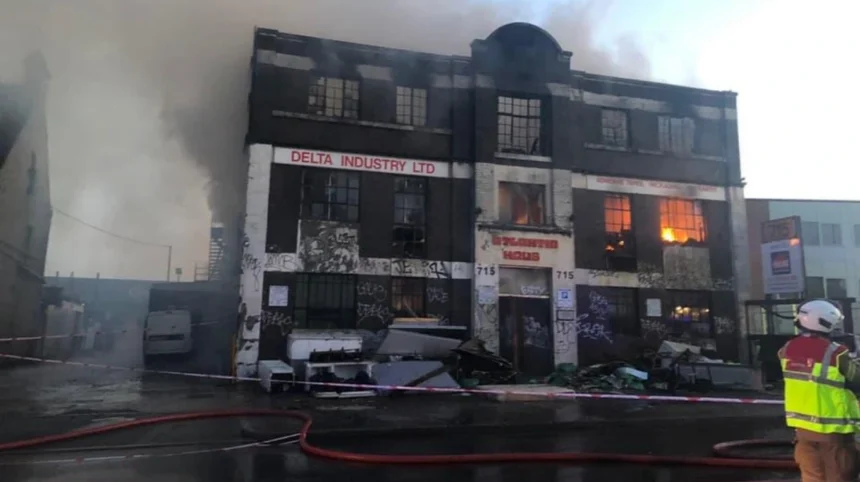
The Neasden fire on 28 August 2026 became a major emergency incident in north-west London after a large blaze broke out at an industrial estate on Hannah Close. London Fire Brigade deployed 20 fire engines and around 125 firefighters, while heavy smoke affected the surrounding area and disrupted Tube services.
- What happened in the Neasden fire?
- Where exactly did the Neasden fire happen?
- How large was the emergency response?
- Why did the Neasden fire produce so much smoke?
- What caused the Neasden fire?
- Why are lithium-ion batteries a concern at waste facilities?
- How did the Neasden fire affect London transport?
- What happened to nearby businesses during the fire?
- What should residents do during a major fire in Neasden?
- How does the Neasden fire compare with other recent London fires?
- What does the Neasden fire mean for fire safety in West London?
- What is the latest status of the Neasden fire?
Neasden is an area of the London Borough of Brent, close to Wembley, the North Circular Road and major commercial and transport corridors. Although the incident is geographically in north-west London rather than West London, its smoke, road effects and public-transport disruption created wider implications for people travelling across the western and north-western parts of the capital.
The incident also highlights an important recurring fire-safety issue in London’s waste sector. Fires at recycling and waste facilities require substantial firefighting resources because burning material can remain hot beneath large piles and can be difficult to extinguish completely. Recent London Fire Brigade incidents show that damaged or improperly discarded lithium-ion batteries are an established cause of several waste-site fires, although the cause of the Neasden fire has not been established.
What happened in the Neasden fire?
The Neasden fire began on Friday 28 August 2026 at an industrial estate on Hannah Close, with London Fire Brigade receiving its first report at about 11:34am. Twenty fire engines and approximately 125 firefighters attended as heavy smoke spread across the surrounding area.
The London Fire Brigade classified the incident as a fire at an industrial location in Neasden. Hannah Close is situated close to major commercial premises and transport routes serving Wembley and Brent.
More than 70 emergency calls were received by the Brigade’s control room reporting the fire. Crews were mobilised from Wembley, Park Royal, Willesden and surrounding fire stations.
The scale of the response reflected the size and location of the incident. Twenty fire engines were deployed, alongside three of the Brigade’s 32-metre turntable ladders.
A turntable ladder is a large aerial firefighting appliance. It provides firefighters with elevated access for water delivery, observation and operations around tall or difficult-to-reach parts of a structure.
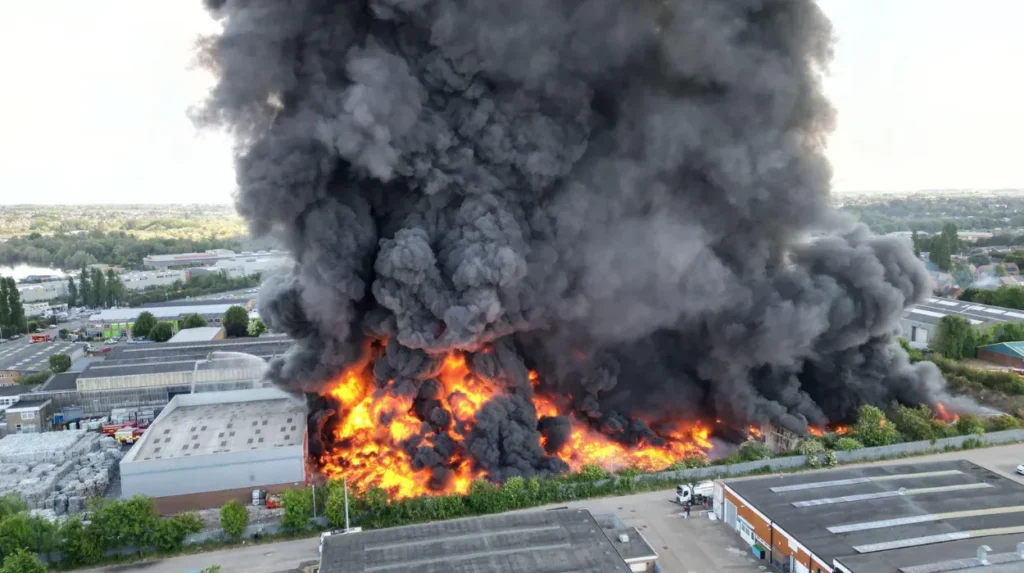
The fire produced a substantial smoke plume. London Fire Brigade advised residents in the immediate area to close windows and doors and remain indoors where possible.
Reports also described an explosion being heard near the site. However, the reported explosion does not establish the cause of the fire. The London Fire Brigade stated that the cause was not yet known.
Where exactly did the Neasden fire happen?
The fire happened on Hannah Close in Neasden, within the London Borough of Brent, at an industrial estate near Wembley Stadium and major transport routes. The site is surrounded by commercial activity, making smoke management and transport coordination important during the emergency response.
Neasden occupies an important position in north-west London. The area connects residential neighbourhoods with major commercial districts around Wembley and Brent.
The Hannah Close industrial estate is particularly significant because industrial premises can contain large quantities of combustible materials, machinery, packaging, waste and other commercial stock.
The location also sits close to the North Circular Road, one of London’s principal orbital roads. This means a major fire in the area can have effects beyond the immediate industrial site.
Wembley Stadium is another important nearby landmark. The stadium is a major destination for sporting events, concerts and large public gatherings. A large emergency incident in the surrounding area therefore requires coordination between emergency services, transport operators and businesses.
The fire also occurred near an Amazon warehouse. The warehouse was evacuated as a precaution during the incident, according to reports. The evacuation was a preventive measure and does not mean that the warehouse itself was the source of the fire.
For West London readers, the main geographical significance is the area’s connection with Wembley, Harrow, Ealing, fulham/hammersmith/">Hammersmith and other parts of the capital through London’s road and rail network.
How large was the emergency response?
London Fire Brigade sent 20 fire engines and around 125 firefighters to the Hannah Close fire. Three 32-metre turntable ladders were also mobilised, demonstrating the substantial scale of the operation and the difficulty of tackling a large industrial fire.
The response began after the first emergency call at approximately 11:34am.
London Fire Brigade subsequently confirmed that around 125 firefighters were involved. The response included crews from multiple stations serving north-west London.
Wembley Fire Station, Park Royal Fire Station and Willesden Fire Station were among the stations mobilised.
Large industrial fires require more resources than many residential incidents because firefighters need to control several risks simultaneously. These risks include structural instability, smoke movement, combustible materials, limited access and the possibility of hidden fire.
The use of three 32-metre ladders was significant. Aerial appliances allow firefighters to attack fires from an elevated position and provide incident commanders with a better view of large sites.
Water supply also becomes important during prolonged industrial fires. Firefighters require a reliable and sustained water source when dealing with large quantities of burning material.
The incident demonstrates why London’s emergency response system operates through multiple stations rather than relying exclusively on the nearest fire station. A major incident can require appliances from several locations to provide sufficient personnel and specialist equipment.
The London Fire Brigade’s response therefore involved both conventional firefighting appliances and specialist equipment appropriate for a large industrial emergency.
Why did the Neasden fire produce so much smoke?
The Neasden fire produced heavy smoke because the blaze involved an industrial site containing combustible material. Large commercial fires generate substantial smoke, and wind conditions can transport smoke beyond the immediate site, creating risks for nearby residents and workers.
Smoke is one of the major hazards associated with large fires.
Industrial premises can contain different materials with different combustion characteristics. Burning waste, plastics, packaging, electrical equipment and other materials can produce dense smoke.
Smoke contains gases and particles that can irritate the eyes and respiratory system. This is why London Fire Brigade advised people close to the incident to remain indoors and keep doors and windows closed.
The advice was specifically directed at people in the immediate area. Residents did not need to approach the incident to assess the situation themselves.
Closing windows and doors reduces the amount of outdoor smoke entering a building. Remaining indoors also reduces direct exposure to the smoke plume.
The Brigade later reported that the smoke had reduced but continued to advise nearby residents to keep windows and doors closed while firefighting operations continued.
Smoke movement also explains why residents several kilometres from an incident can sometimes see a large plume. Visibility of smoke does not automatically mean that the same concentration of smoke exists everywhere.
For people in West London and north-west London, official emergency-service updates remain the appropriate source for determining whether specific local precautions are required.
What caused the Neasden fire?
The cause of the Neasden fire has not been established by London Fire Brigade. Reports of an explosion occurred during the incident, but an explosion alone does not identify the ignition source, and officials had not confirmed a definitive cause when the incident was reported.
This distinction is important.
Fire investigators establish causes through evidence collected after and during an incident. Investigators examine the fire pattern, damaged equipment, electrical systems, materials and other potential ignition sources.
The presence of waste or recycling material does not automatically prove that a battery caused the fire.
Lithium-ion batteries are, however, an important fire-safety concern across London’s waste sector.
London Fire Brigade has repeatedly attended fires at recycling and waste facilities where investigators identified lithium-ion batteries as the probable cause. A July 2026 fire at a Southwark waste transfer facility was attributed to the failure of a lithium-ion battery.
An August 2026 recycling-centre fire in Ilford also involved a damaged lithium-ion battery in a refuse pile. The incident destroyed an industrial refuse compactor and around three tonnes of recycling material.
These examples demonstrate the wider risk but do not establish that a lithium-ion battery caused the Neasden fire.
That distinction should remain clear in any factual reporting of the incident.
Why are lithium-ion batteries a concern at waste facilities?
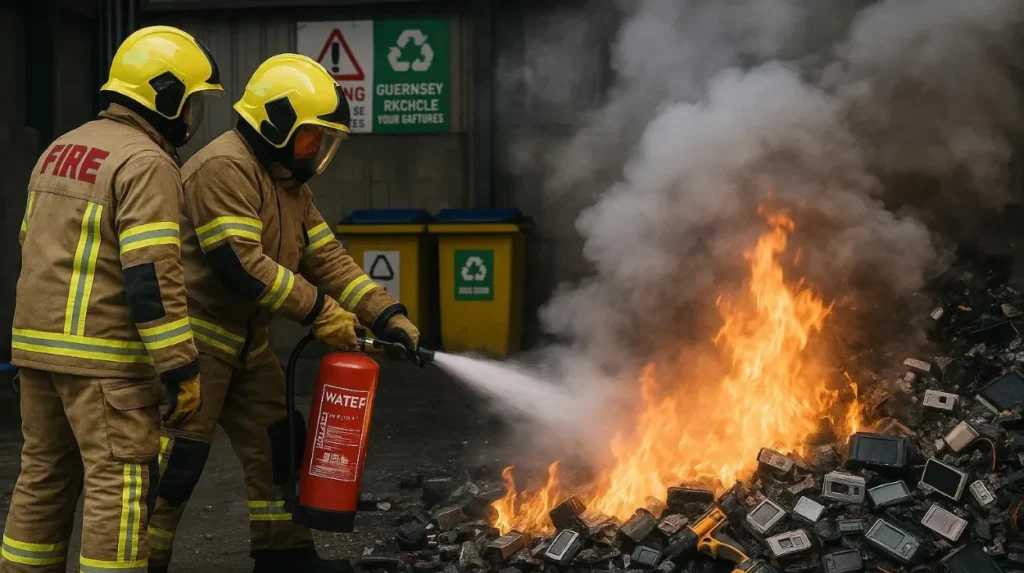
Lithium-ion batteries create a significant waste-sector fire risk because crushing, damage, short circuits or other failures can release stored energy and ignite surrounding material. London Fire Brigade has repeatedly linked lithium batteries with fires at recycling and waste facilities.
Lithium-ion batteries are used in many everyday products.
Examples include smartphones, laptops, tablets, electric toothbrushes, power banks, toys, cameras, headphones, e-bikes and e-scooters.
Problems occur when batteries enter general waste or recycling streams.
Waste collection vehicles use mechanical compaction to compress material. A battery inside a discarded electrical item can become crushed during collection or processing.
Damage to the battery can result in thermal runaway. Thermal runaway is a rapid self-heating process in which a battery cell generates increasing heat, potentially leading to fire or explosion.
London Fire Brigade has specifically warned that damaged lithium-ion batteries can ignite rapidly and produce difficult-to-control fires.
Recent London incidents provide clear examples.
At a recycling centre in Wimbledon Park in July 2026, around 80 tonnes of household waste were involved in a fire. London Fire Brigade recorded a lithium-ion battery as the most probable cause.
At a waste facility in Edmonton in July 2026, around four tonnes of general waste were destroyed. The Brigade stated that the fire was caused by the failure of a lithium-ion battery in a power bank.
These incidents demonstrate why safe battery disposal is relevant to households throughout West London, north-west London and the wider capital.
How did the Neasden fire affect London transport?
The Neasden fire caused significant transport disruption because emergency operations took place close to major Underground routes serving Wembley and Neasden. Metropolitan line services were suspended, while Jubilee line services were also disrupted as crews responded.
The Metropolitan line was fully suspended during the incident.
The Jubilee line also experienced serious disruption, including a suspension between Willesden Green and Wembley Park during the emergency response.
Transport disruption occurred because the emergency services needed safe operating conditions around the fire.
Large emergency incidents can require roads near the scene to be restricted. Fire engines need sufficient space to enter, position equipment, operate aerial appliances and establish safe working areas.
Underground services can also be affected when smoke, emergency activity or access restrictions create operational concerns around nearby stations and railway infrastructure.
The impact extended beyond local residents. People travelling towards Wembley, Neasden and surrounding areas faced delays and altered journeys.
This is particularly relevant to West London commuters because Wembley functions as an interchange between several transport corridors.
During major incidents, passengers should check live information from Transport for London and National Rail before travelling. Emergency conditions change rapidly, so journey information published earlier in the day can become outdated.
What happened to nearby businesses during the fire?
Nearby businesses were affected by precautionary safety measures during the Neasden fire. An Amazon warehouse close to the incident was evacuated, while smoke and emergency operations affected access around the industrial estate and surrounding transport network.
Business continuity is an important part of major industrial-fire incidents.
Industrial estates contain multiple businesses operating close together. A fire at one premises can therefore affect neighbouring companies even when flames do not reach their buildings.
Evacuation provides a straightforward protective measure when smoke or other hazards affect nearby premises.
The reported Amazon warehouse evacuation illustrates this approach. The warehouse was evacuated as a precaution rather than because it was identified as the source of the fire.
Other businesses in the surrounding area also faced disruption caused by smoke, emergency vehicles and transport restrictions.
Employees travelling to industrial estates can be affected by road closures and public-transport disruption even when their workplace remains physically intact.
Businesses should therefore maintain emergency procedures that cover evacuation, communication, staff accountability and alternative access arrangements.
The Neasden incident provides a practical example of why commercial sites close to industrial operations require emergency planning.
What should residents do during a major fire in Neasden?
Residents should follow instructions from London Fire Brigade and other emergency services, remain indoors when advised, close windows and doors during heavy smoke, avoid the incident area and call 999 only for genuine emergencies requiring immediate assistance.
The most important action during a large smoke-producing fire is to follow official instructions.
When London Fire Brigade advises residents to stay indoors, people should avoid unnecessary outdoor exposure.
Windows and doors should remain closed while smoke is affecting the immediate area.
Ventilation systems that draw outdoor air inside should also be considered when smoke is present.
Residents should avoid travelling towards the incident to watch or photograph the fire. Crowding around an emergency scene creates additional challenges for firefighters and can obstruct emergency vehicles.
People with urgent medical concerns should use the appropriate emergency or healthcare service.
The emergency number for a fire in the United Kingdom is 999.
Residents should also avoid spreading unverified information through social media. The cause of the Neasden fire was not initially known, so claims about deliberate ignition, explosions or specific materials were not established facts.
The London Fire Brigade incident page provides the most authoritative source for official updates about the emergency.
How does the Neasden fire compare with other recent London fires?
Recent London waste-site fires show that large industrial and recycling incidents require substantial firefighting resources, create smoke risks and frequently involve damaged lithium-ion batteries. However, the confirmed cause differs between incidents, so each fire requires separate investigation.
The Neasden incident occurred during a period when London Fire Brigade had already attended several significant waste-related fires.
In May 2026, a warehouse fire in Neasden near the North Circular Road involved 12 fire engines and around 80 firefighters. A ground-floor workshop was destroyed, with fire spreading to offices and the roof. The cause was recorded as undetermined.
In June 2026, a warehouse fire at a business park in Brent required 25 fire engines and around 150 firefighters. Around 70 people from a neighbouring residential block were evacuated as a precaution.
In July 2026, a Wimbledon Park recycling-centre fire involved around 80 tonnes of household waste, with a lithium-ion battery recorded as the most probable cause.
These incidents demonstrate that industrial fires can vary considerably in scale and cause.
They also demonstrate the importance of separating confirmed facts from general fire-risk trends.
The Neasden fire remains a distinct incident. Its cause should be described according to the findings released by the London Fire Brigade or relevant investigators.
Explore More Area Guide
After-School Activities in West London: Complete Guide 2026
Children’s Attractions in West London: Family Guide
What does the Neasden fire mean for fire safety in West London?
The Neasden fire reinforces the importance of safe waste disposal, battery recycling, commercial fire planning and rapid compliance with emergency instructions across West London. Large industrial fires demonstrate how one incident can affect residents, businesses, roads and public transport.
The incident is relevant beyond Neasden because waste and commercial properties exist throughout West London.
Households regularly dispose of small electrical items containing lithium-ion batteries. Examples include old phones, rechargeable headphones, power banks, toys and electric toothbrushes.
These items should not automatically be placed in ordinary household waste.
London Fire Brigade advises residents to use appropriate recycling arrangements for batteries and electrical products. Local-authority recycling guidance provides information about available collection facilities.
Businesses also have responsibilities for maintaining suitable fire-safety arrangements.
Commercial premises need clear evacuation procedures, suitable fire detection, accessible emergency routes and effective communication systems.
Industrial operators handling combustible materials require additional consideration because fires can develop rapidly and generate substantial smoke.
The wider transport implications also matter.
Wembley, Neasden and surrounding Brent areas have dense transport connections. A major emergency can therefore disrupt journeys far beyond the immediate fire site.
The Neasden incident shows how fire safety, environmental protection, public transport and emergency planning intersect within a densely populated London environment.
What is the latest status of the Neasden fire?
London Fire Brigade initially described the Neasden incident as an ongoing operation involving 20 fire engines and around 125 firefighters. The Brigade stated that the cause was not yet known and advised nearby residents to remain indoors because of smoke.
The Brigade later reported that the smoke had reduced while firefighting operations continued. Its community updates described the incident as a prolonged operation, with crews expected to continue firefighting work into the night.
This is an important distinction between bringing a fire under control and fully extinguishing a fire.
Industrial fires can contain concealed or deep-seated hotspots. Firefighters therefore remain at scenes after the main flames have reduced to identify and extinguish remaining sources of heat.
The final investigation can also take place after firefighting operations have ended.
For residents, commuters and businesses, official updates remain the most reliable source of information about changing conditions.
The Neasden fire also demonstrates why emergency information should be checked before travelling through the Wembley and Neasden area during a major incident.
The Neasden fire of 28 August 2026 was a major industrial emergency in Brent, north-west London. It involved 20 fire engines and around 125 firefighters, generated heavy smoke and caused significant disruption to the Metropolitan and Jubilee Underground lines.
The fire occurred at an industrial estate on Hannah Close, close to Wembley Stadium and major commercial and transport infrastructure.
The London Fire Brigade had not established the cause when the incident was reported. Claims connecting the blaze to a particular ignition source should therefore be avoided unless confirmed by investigators.
The incident is nevertheless significant in the wider context of London’s waste-fire problem. Several recent fires at waste and recycling facilities have involved lithium-ion batteries, demonstrating the importance of responsible disposal of rechargeable batteries and electrical products.
For West London residents and visitors, the key lessons are practical: follow emergency instructions, stay away from active fire scenes, keep windows and doors closed when advised, check transport information before travelling and dispose of batteries through appropriate recycling channels.
What happened in the Neasden fire?
A major fire broke out at an industrial estate on Hannah Close, Neasden, on 28 August 2026. London Fire Brigade sent 20 fire engines and around 125 firefighters to tackle the blaze.